“Is that a 35mm lens?” The question only reached me after I had already made my way past him. Under most circumstances, spontaneous interactions such as these go ignored. Especially in large cities, people are generally in a rush, wear headphones blasting music (or, in the case of San Francisco, I assume informative podcasts about anything AI), or simply don’t feel like it. All of these circumstances are fair, by the way, and I have definitely been guilty of each of these in the past, and I’m sure I will continue to be in the future. Today, though, I wasn’t quite going anywhere anyway, and my only plan was to simply follow the city noises and feel its vibrations reverberate through my soles.
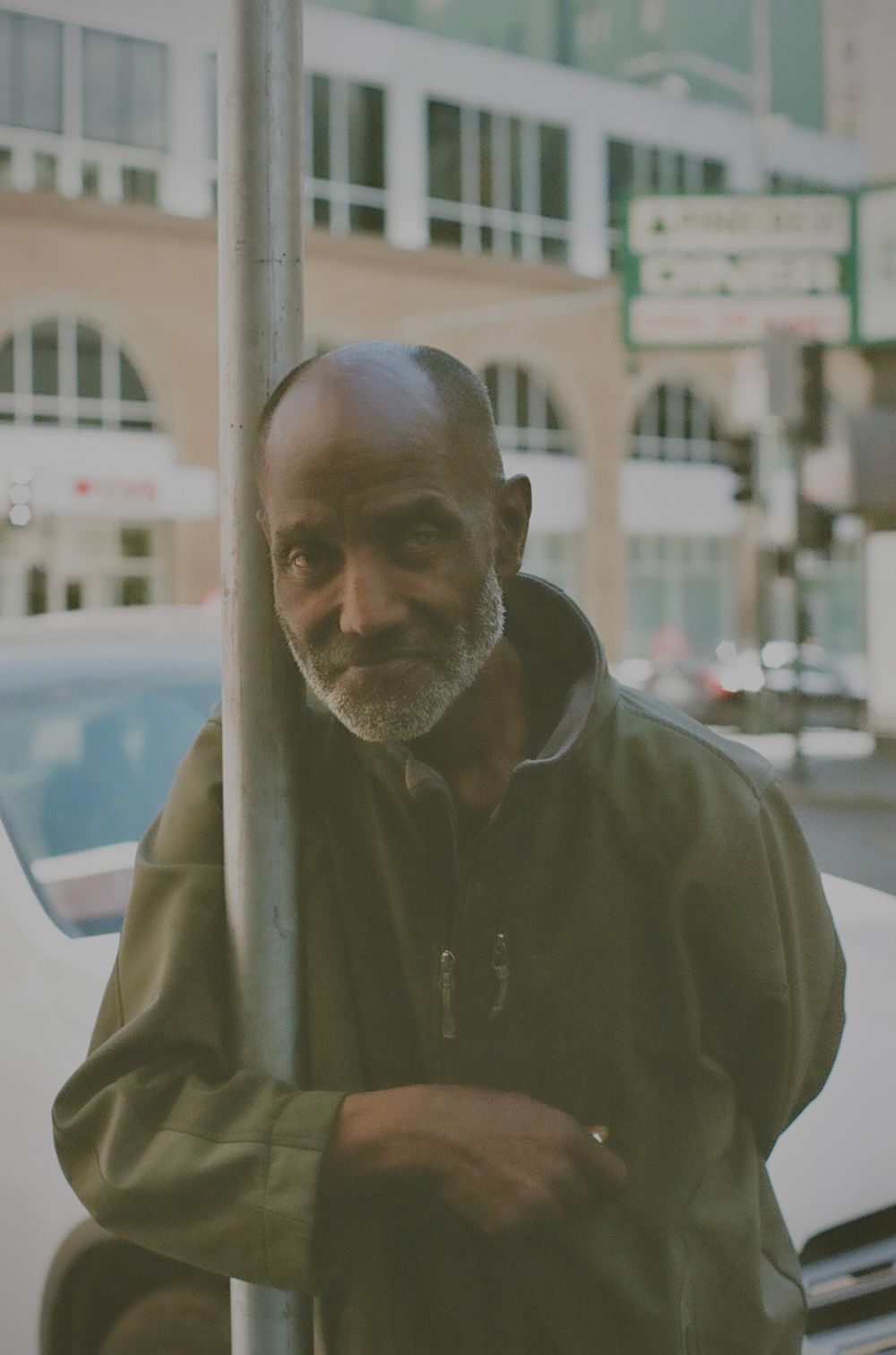
I turn around and come face to face with a man who I later find out is named Ron. Within the next ten minutes, I learned more about Ron than I could learn of a fellow Dutch countryman in, give or take, five months. Americans tend to wear their hearts on their sleeves and you will often be pulled into the most unexpected stories. Speaking about this with my Egyptian friend, I have come to find that this is a general observation non-Americans tend to make about Americans. “You guys truly like to talk!” I proclaimed to a girl from San Clemente I met a couple of days later. She had to stop herself in her track and could do nothing but agree.
Ron and I briefly talked about the camera which, although I am slowly considering it as my closest travel partner, I admittedly know very little about. He asked where I’m headed and when I’m from and we quickly found a few similarities to bond over. “I’ve been to the Netherlands!” he shared excitedly – I find Americans are more interested in countries beyond the U.S. than what we tend to give them credit for. I briefly talked about my plans to travel further south to make my way across the U.S. and glanced over my previous experience in the hot, so hot (so! hot!) city of Vegas, which is where he had some family currently residing. Once we reached the topic of Phoenix, he continued to tell me about a long-time high school friend of his named Eddie Murray who had had a phenomenal sports career and had landed his name in the Hall of Fame. What this had to do with Phoenix, I don’t quite recall or I simply never caught it. Around us, the chants of hotel workers striking for a better healthcare plan echoed through the air, and Ron had a tendency to take a few paces back every now and then to clear his throat so some of our dialogue unfortunately dissolved in the space between us.
I did learn that Ron was originally from Maryland but relocated to California sometime during high school due to his parents taking on a different career path. During his own career, he had worked for a U.S. airline company which had taken him on assignments all across the world. I asked what his favourite destination had been, curious to hear more, but he simply couldn’t pick – and much more easily offered up his least favorite place. This had been Israel on account of people being rude and unwelcoming, despite them all having to work on the exact same thing. To an extent I could resonate with the sentiment, although I have been lucky enough to experience the opposite. Although the U.S. is far from a perfect place, the hospitality of (some of) its people make up for it.
We quickly jumped from talking about nazi’s fleeing to north and south America post WWII (and was recommended to watch The Boys from Brazil) and dived into the state of current world affairs – a conversation that is perhaps not most suitable in front of a Jack in the Box one block off from Union Square. “It’s a horrible world and terrible days,” we concluded, solemnly and saddened. We wished each other the best of luck, and determined we were friends now. I ended up scurrying off deeper into SF and left him at the same lamppost where we’d initially started our conversation. I briefly spoke to him again three days later, to show him the photo I’d taken and offer a meal. He wasn’t doing too well, sleep and malaise set in his face, but he remembered me, “his friend from the Netherlands”. After I had picked up some iced water for him, I returned to find him awkwardly trying to catch a few seconds of shut eye with his newly acquired beanie drawn over his ears and his oversized sweater hugging his frail body. I put the water down, made sure not to disturb him and once again continued onwards. We often feel powerless in the face of inequality, and to an extent I think we are, but there is strength in connection. I am aware it is far from enough, but sometimes it is all we have.
I never ended up asking how he had landed on the cruel streets of San Francisco, as it’s not my right to ask. I have slowly come to realise that knowledge is shared, never demanded. Especially not as an outsider, whose entire time here is a testament to privilege. And as much as Americans like to talk, there will always be things that remain private and theirs. Maybe they’re not so different from the Dutch after all.
While most Dutch people will often shy away from the invasive sight of a camera lens pointing toward them (it would be an infringement of our privacy after all), the exact same thing can ignite a very opposite response among Americans.
On my first day back in San Francisco, I chose to meander along its hilly roads to restrengthen the few muscles I was left with after doing very little intensive hiking in the Netherlands. This would also be my very first time properly shooting film in a city setting – and in general, it was really pretty much my first time experimenting with street photography overall. Over time, I had grown much more comfortable taking shots of my loyal (and particularly patient!) golden retriever as she skipped her way through muddles and puddles alike, sat still atop tree trunks or diligently listened while I asked her to “sit and stay” at the most random of moments, or even more preferably I liked taking photos of non-moving models like flowers and plants. I had not quite dared to venture in the realm of human photography before, besides taking pictures of friends or family members of course. There is a certain awkwardness that needs breaking, and I personally believe there has to be some consent that I not yet had the guts to ask for.
Making my way along North Point from Fisherman’s Wharf to the Palace of Fine Arts, my newly-acquired yet trusty film camera dangled on my chest with each strutting step. I had a total of 36 shots to fill (realistically more like 30, knowing there would be bound to be more than one failed attempt), and I was keen to eventually capture more of a personal face to San Francisco besides just shots of its unique mix of architecture, old cars and oversized American flags. As I walked down a road of expensive mansions with over-the-top Halloween decorations (one sign read: “No trespassing: we’re tired of burying the bodies” with some blood plattered over and around the lettering), a man dressed in a blue overall one block away seemed to be staring right at me in complete stillness. From afar, a small part of my brain even entertained the thought that one of these houses had decided to decorate their front yards with a life size old-timey scarecrow. Once I came closer, I realised that was not the case (bummer, because if it had been, I for sure would have taken a photo!) and instead it was a middle aged man gently smiling right at me, the corners of his lips tucked upwards and pinching into his cheeks. I smiled back and nodded my head at him in acknowledgment and respect, still getting into the level of street niceties common in the U.S. (a few minutes prior to writing this, a man told me “God bless you” as we passed each other on a street corner down in Mission – people are truly kind here).
“Ah, I was posing for you!” he jokingly called out as I had almost made my way past him – head instinctively lowered to reduce any form of further awkwardness. We briefly continued to quip back and forth, talking about how I would have felt too self-conscious to click away at him as much as I wanted to, while he instead instilled that I can (and should! He had recently seen the movie Civil War and felt in awe at the courageousness of the journalist on the front lines of the war) on the account of it being San Francisco where you can “do as you want”. By telling me this, in a tone so jovial that I couldn’t help but feel instantly relieved and comforted by his words, he helped me break down some of the highest bricks that constructed the barrier I had to climb in order to feel comfortable documenting street life. Just as I was about to ask whether I could perhaps take his photo – I could already imagine the way his kind face would reflect on film and was itching at the prospect – the garage door opened up behind him and it was time for him to get back to work. Uncertain whether to linger around and if anything, at least ask, I didn’t quite take long enough to linger on that thought and instead thanked him for his time, advice and confidence and continued on.
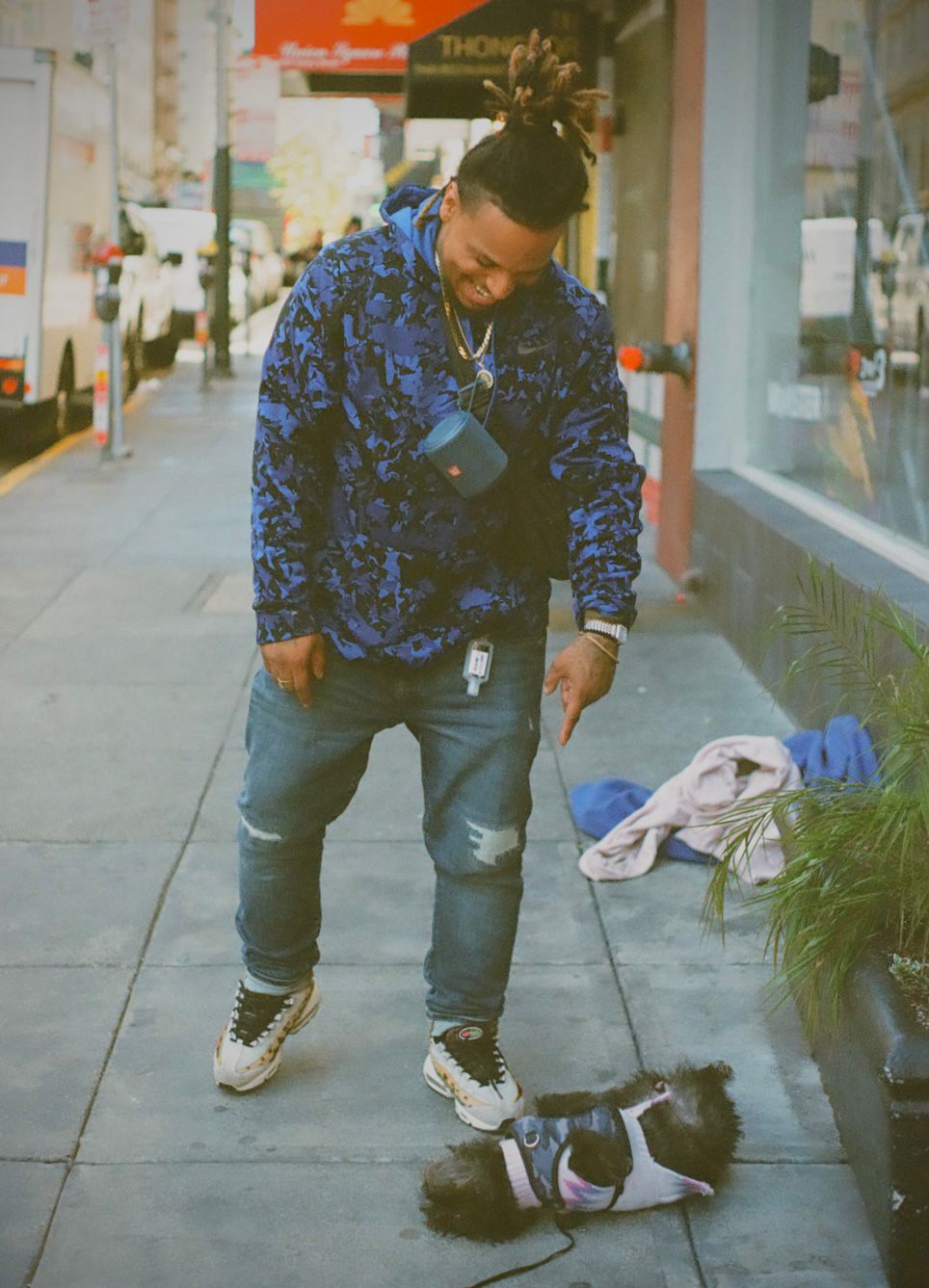
For most of the day, I regretted not taking his photo. I replayed the conversation in my mind more than once and thought of all the conversational gaps during which I could have mustered up enough confidence. But ultimately, I had to accept that some things simply aren’t meant to be. Besides, a few days later, once I’d grown more accustomed to interacting with people on busy streets, someone else jokingly told me he was instinctively posing at the sight of my camera. I responded that I would love to take his photo, and I did. It isn’t the best thing I’ve shot, it isn’t even particularly good, as his face is out of focus and the light seems to fall flat. But what I saw looking at him through the little viewfinder on my camera was pure joy and playfulness. And confidence – the American amount, of course. I’m glad I got to capture that.
It wasn’t until my last day in New York City that I was told how to stay safe in the most populated city in the United States. At that point, I had already spent five days in upper Manhattan, taking the metro up and down at all times of the day (and night) and continuing to walk around with my head held up high even after the sun had sunk behind the buildings shooting up towards the sky. Additionally, I had spent another five days in Brooklyn, where one of my main activities had been to smile at random strangers and accept interactions wherever they arose, be it with a random Russian man on the beach in Coney Island, or an Albanian employee at an immersive art installation. It was because of that final reason that I suddenly found myself entangled in a conversation – although it was more of a one-sided lecture from her part – about safety in New York City.
I had just spent a couple of days walking around for eight hours a day, feeling unable to keep up with the growing list of things I still wanted to experience and see. On my last day, I had decided to venture out somewhat earlier than usual and make my way from Crown Heights in Brooklyn up to 34th Street in Manhattan to attend the biggest St. Patrick’s Parade in the world. Due to me naturally doing no prior research (I never learn), my expectations exceeded what I ultimately encountered and I quickly found the endless noise of countless bagpipes to become repetitive. For some reason, I had expected the parade to resemble carnival as we celebrate it in the Netherlands and had counted on seeing colourful floats, boisterous Irishmen and Americans alike, and, of course, a lot of Guinness spilled from cups on pavements, shirts and shoes. Nothing was less true and instead I was met with American families lining up behind the barricades that closed off a very large portion of Fifth Avenue, all collectively watching, smiling and clapping along as multiple Irish Associations make their way uptown surrounded by music. Signs like “Kick out the English” received even more clapping. Overall, the general atmosphere seemed to be positive, with over 12.9% of New Yorkers identifying with the Irish flags and banners that proudly waved in the wind – despite having lived in the U.S. all of their lives.
I later found out that the drinking kicks off towards the evening and mostly takes place in Irish pubs and clubs – but for me the fun unfortunately tends to end once festivities such as these move away from the streets into the indoors and so I saw very little of this. After ten minutes of trying to integrate among countrymen with whom I suddenly felt like I shared little cultural similarities, I began wondering: just what would be the best way to cross Fifth Avenue? I saw multiple food deliverers, all with fast black e-bikes decorated in flashy colours to visualize country flags to which they feel a connection, sported with loud speakers to keep them company and large wool mittens to warm their hands, wondering the same thing. I decided a good place to start would be to walk up to the finish point, expecting to find some sort of festival setting up there for paraders to come together and unite. On my way there, I was handed a personal manifesto documenting the truth behind JFK’s assassination (it begins: “I dreamt vehicle behind shot JFK”, which makes the most sense out of the entire text), somehow successfully revitalised my inner “walking-through-Amsterdam-during-the-weekend” energy (which very much consists of looking pissed off at anyone walking too slow for your liking) and left behind me the sound of bagpipes which still sleepily drifted in the air even three blocks down but was increasingly challenged by the sound of endless honking, revving engines, and New York City chatter.
I learned how to stay safe in this loud city from a woman who’d positioned herself along the parade around 70th Street with her husband and Cocker Spaniel named Clancy. After a month in the U.S., I had finally gotten over my irrational hesitation to ask people whether I could, please, pet their dog as at that point my missing of dogs, especially my own back at home, trumped the final shred of embarrassment I felt going up to random people. Besides, on St. Patrick’s Day everything felt possible, even without an ungodly amount of alcohol running through my veins. I first seized up the dog’s friendliness from afar, sneaking a picture to see how it responded to the attention. Within seconds, its tail swung beyond control and it began tugging at its owners’ leash – my cue to go up. I pointed toward the dog, a tiny bundle of excitement and friendliness I have truly only ever seen displayed in inner city dogs, and made a gesture that was meant to display my kindly asking permission. She nodded back, excitedly, but still refrained from any sort of further communication between us. Perhaps she was sizing me up too: a solo traveller with a dark green cap pulled over their eyebrows and wild strands of hair escaping from every side. Some Americans seem to be at all times stuck between wanting to be overly friendly, and lacking the general trust in others to do so. Indeed, almost 71% of the questioned Americans are less confident in each other than 20 years ago.
Within five seconds, her dog was making attempts to lick my face, doglike behaviour I will only really be able to bear from my own. Perhaps I passed the test, because within an additional five seconds, the owner began talking to me and telling me he could easily keep it up for as long as I would pet him (prompting me to stop petting him). I told her I was at all times surprised about how friendly NYC dogs are, a phrase I caught myself repeating with the next dog I pet (a three year old basset hound whose ears almost trailed the floor even when it sat upright). Like most Americans, and New Yorkers, this woman exuded a manner of immediate friendliness that will catch most Dutchies like myself off guard. I resisted from taking a step back when she touched my arm as I did not want to create a cultural barrier between us and instead chose to put up with the lack of personal space I suddenly found myself in. She asked if I had come here just for St. Patty’s, which once more made me realise this was a bigger thing than I made it out to be. I responded that I was Dutch and that no, I’d been solo travelling for a month – words that drifted in the air but failed to be caught by her even though we were only 10 centimeters apart (4 inches, for you Americans). She had somehow understood that I had only just arrived today, on the most perfect of days, if it were up to her to rank them. She told me she was a born and raised New Yorker but that she was fully, a 100%, genetically Irish, an identity marker she proudly carried within her and had no issue boldly stating either. Not just that, but even her dog was Irish, even though I am pretty sure he had never even touched Irish soil. Without asking, she began to tell me about how to stay safe in New York City.
She started off by saying that she had been assaulted three times in the past couple of years – a rate vastly exceeding the one that had pertained through her earlier years (do not quote me on this but I am guessing she must have been around 60 years old). She added that these men had not been out for money either – but for something else, the exact words unspoken but nestled in the tone with which she presented her experiences. She went on to say that the situation in the city has dramatically changed (for worse) due to the rising influx of immigrants making their way into a place that has no space nor resources for them. “They’re angry, these immigrants,” she said. I nodded, curious where this would go, “because they come here, expecting something better, but they find something worse.” I had also noticed how the expectations of a life in America was often far detached from reality. Even the people I had met who had succeeded in making their living here, pined to go back home one day – and it doesn’t take much to figure that having absolutely nothing can often have people act in the worst of ways. “If I can give you any tip, any tip, it would be this,” she started. I still had to push down the desire to take a step back as she gently pinched my arm to create some sort of fabricated connection between us. I imagined she was my grandmother to make it any easier, firmly planted my feet to the ground and even leaned in a little to show I was listening. Here goes, I thought. A New Yorker, giving me real New York City advice.
“First: when you walk alone, you keep your eyes planted to the floor”. I thought back to the fantastic things I had seen walking around the city at all moments of the day, seeing buskers on random street corners and in subway stations, catching glimpses of parents gently navigating their younger children through the busy streets in Brooklyn, watching a toddler spinning around certain metallic wheels that were not meant to be turned – let alone touch – and sharing a laugh about it with another passerby. I had learned that even in a city as big as New York, you could run into the same people twice (I swear, it happened, and I wouldn’t have noticed if I’d just looked to the ground). I also thought about all the things that we do begin to block out as time passes: the garbage riddled streets, the subway stations whose structures decay by mold and piss, my friendly smiles that went ignored, or worse, acknowledged and then ignored when walking through Williamsburg on my second day back in the city. I reflected on all the people slumped against walls in busy and calm streets alike, how they go unnoticed by the thousands of people passing them by every day because of this piece of advice – don’t look up. Ignore the despair of humanity when you’re faced with it.
“Second: when you take a subway, you don’t talk or interact with anyone.” I was instantly reminded of just a couple of hours ago when I had intentionally made a bit of a fool of myself to crack a smile from people around me (somehow so American, and incredibly embarrassing now that I reflect back on it). The subway was experiencing a power outage – a typical New York City experience I’d only ever heard about in tv shows like “Broad City” and one that I, despite the inconvenience, almost felt excited about. I hadn’t quite caught the stations between which the outrage occurred (Subway speakers are atrocious and I am incredibly impressed at the seasoned commuter who somehow manages to understand them) and so asked the couple seated in front of me to clarify it. The man told me it only affected the following three stations, which made me stand up immediately, announcing I might as well walk then. His partner gently nudged him and pointed out that it wasn’t the next three, but five stops that would be affected, to which I slumped back into my seat and jokingly waved away my earlier commitment to walking and thanked them for the heads-up. We shared a brief laugh about my apparent laziness. I thought about the thousands of interesting people you see in Subways every day, the “don’t be someone’s subway story” people, who unabashedly smoke joints, balance things on their heads, and do skateboard tricks. Or just those who are trying to catch a few seconds of sleep (people in NYC generally seem really, really tired), who have interesting conversations, read books or unbox their newest shoe purchase and patiently run the laces through them.
I was also reminded about the people using the busy commuters network to share their life stories about their steady decline into poverty (war veteran, unemployment, loss of housing, you name it) as an appeal for people to donate any spare chance they might have, and how any such story usually evoked the cruel response of people mindlessly going through the motions of yet another day. People would instantly stare down at their phones once such a story was passed on in a subway cart – and we’d all catch ourselves going quiet as conversations were dimmed and we listened to the life of another in complete silence but did absolutely nothing to fix it because what could we possibly do? There was a certain level of disconnect here, perhaps. In that moment, I felt as though we were all forced to face the undercurrents of our modern society, one of the many facets that have not worked out well, while at the same time many of us were reaping the benefits of th e same society. When looking around, you’d see shopping bags filled to the brim, expensive phones clenched tightly and designer shoes planted to the floor. For me personally, my entire being there was, in a way, a privilege not afforded by many. Maybe it is this complete detachment from one life to another that has resulted in a decay of human compassion. There is this belief that one dream can only really exist at the expense of another – there is no rich without the poor.
This isn’t just an American thing, by the way. Although it might be somewhat easier to start going blind to terrible situations in NYC, mostly due to there being so many, very similar trends are happening all over Europe – with migrants being washed ashore eliciting little real change being a prime example. Still, heartlessness, indifference, and callousness are not going to improve the world and perhaps we can only do better once we know, see and hear, where things are going wrong.
“Third: you never walk around Central Park as soon as dawn hits and you should always walk along the side of the street that has doormen,” which by the way is only really possible in richer neighborhoods as they are more likely to have doormen. Although she definitely had somewhat of a point here, with certain parts of Central Park being unsafe to walk through at night, especially as a young person and, despite my feigned level of confidence, still very much a tourist. But, I still couldn’t help but reflect on the fantastic park walk I’d done the day before. All the way up to the top by sunset, and back down again once the sky had turned all black and the New York City skyline simmered above me filled with a million lives that just kept on living. I thought of the couples, many of whom seemed to be queer, I had seen stroll around hand in hand as soon as the park had begun to settle down and darken. I thought of people unwinding on benches after long work days, stretching out on fields, throwing balls for their dogs to chase and groups smoking together so their laughs would echo over the water like a cascade of waves that just filled my heart with such joy.
She wrapped up her “life lessons for a tourist in NYC” as I am sure she would have categorized it herself by urging me to buy pepper spray and removing the safety cap every time I set foot outside. I thanked her because she genuinely had no bad intent in telling me any of this, despite knowing I had not and probably would not take her up on any of these points. On the contrary, I realised that her lived experiences, although I am sure valid, did not match my (albeit incredibly short) experiences. I personally couldn’t relate to the sense of general unsafety that seemed to riddle her body when walking around at night or alone, and if it were up to her I had been doing safety all wrong. I have been told over and over that NYC and the U.S. aren’t safe places to be. And although I have listened to these concerns and put them in practise more than once (I have crossed streets to evade strange situations and turned around once places would darken too much), I still could not help but shake the general feeling of safety and trust which I have had the privilege to foster during my childhood and early adult life in the Netherlands. I am not naturally wary of people and I do not assume the worst, and I have attempted to apply both of those feelings to most situations abroad. Of course, her reasons have to be grounded in some sort of lived reality (I doubt any fear can be completely ungrounded), but I did leave feeling just how unfortunate it is that some of us will live in the perpetual fear that inhibits us. It is a shame that we do not look around more, interact with our surroundings and the people around us. I am just one of billion, and there are billions more, and although being wary is important and unfortunately very necessary in the world we live in, there is a certain level of moderation we must all strive toward. She left off saying that, as bad as it is, there is unfortunately nothing we can do about “it”, being the current state of immigration policies in NYC that made her feel so unsafe. I pondered on this for a moment, initially agreeing as I too felt helpless and unable to change a system that has nestled its way into every fragment of society, but then began to realise that there are probably so many things we can do. Perhaps a good place to start, would be by looking up more.
You, like most people, might never have heard about Clustered Regularly Interspaced Short Palindromic Repeats gene editing, or CRISPR gene editing for short. This is a recently discovered gene editing technique (a methodology that allows to modify the genetic information of an organism) in the field of molecular biology that earned Jennifer Doudna and Emmanuelle Charpentier the Nobel Prize in Chemistry in 2020. It is only the sixth and seventh Nobel Prize to be awarded to women in the field of chemistry, the first shared by two women, and it recognizes Doudna and Charpentier’s long and fruitful career in science.
Born in Washington D.C in 1964, but raised in Hawaii, Jennifer Doudna’s life is one defined by breakthrough achievements in science, education and activism. In a recent biography on Doudna by Walter Isaacson – known for the biographies of Elon Musk or Steve Jobs – she narrated what it was like to grow up on an island and attend a school where she was the only blond, blue-eyed kid. Surrounded by nature, her interest in biology first and in genetics later became an obvious choice for her educational background. Thankfully, her choice was very much encouraged by her parents, both with careers in teaching. Doudna first truly realized she could “do science” in 1985, during college practices, when she was mentioned in a scientific paper about bacteria after successfully growing the organisms.
Encouraged again by her parents, she applied and got accepted into Harvard that same year. It was there, working in the laboratories of different distinguished professors in the field, that she discovered her passion for DNA first and RNA later. After finishing her dissertation, she asked Polish biologist and a later Nobel Prize laureate Jack Szostak to do her doctoral research under his supervision. Investigating RNA at a time where major discoveries in DNA were still being made was risky, especially for Doudna who was only just starting her career in science. “Never do something that a thousand other people are doing”, a guiding principle for Szostak, convinced Doudna of embarking into the scientific journey of RNA research.
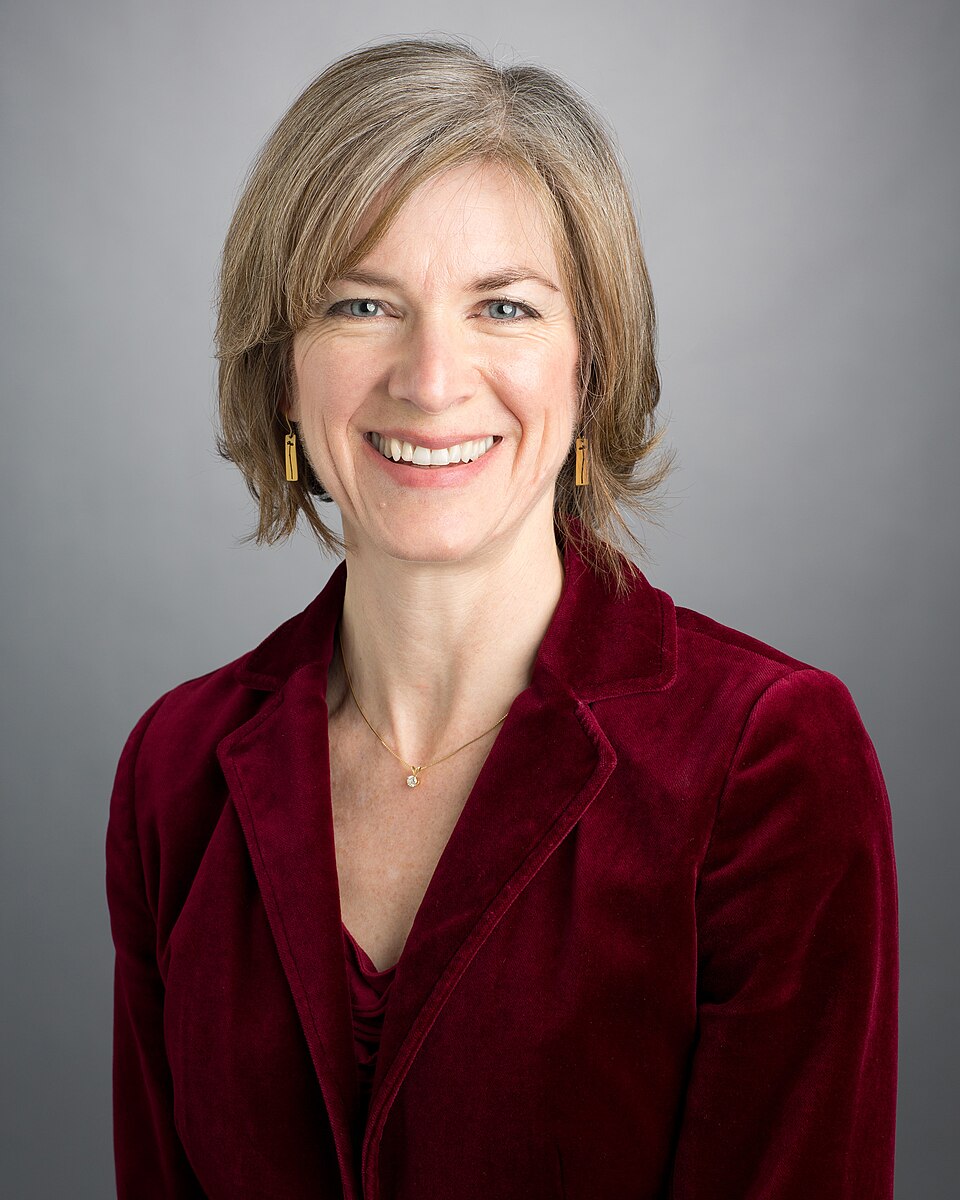
A portrait of Jennifer Doudna in 2013
During her PhD, she published various important and novel articles in prestigious scientific magazines. It made sense, then, to continue her research and after obtaining her PhD, Doudna started her postdoctoral research in Tomas Cech’s lab, then recently laureated with the Nobel Prize. Despite moving from the University of Colorado to Yale, she kept investigating the RNA molecular structure until Doudna and Cech were finally able to determine the location of every atom in an RNA molecule. This discovery, essential for the Nobel Prize she would end up winning later, began a “quest to translate basic science about RNA into a tool that could edit genes”, Isaacson explained in Doudna’s biography.
Now a leading figure in a newly established field, Doudna continued to work at Yale until 2002. Afterwards, she felt it was time for a change and moved to Berkeley to both continue her research on RNA as well as teach classes, as this way she could contribute to public higher education in the U.S. It was during the early 2000s when Doudna became interested in the recently discovered CRISPR mechanism and in the genetic editing technique associated to CRISPR that she would contribute to discover.
Explained in layman terms,CRISPR gene editing is a tool used by scientists to, as redundant as it sounds, edit genes and consequently change them. Think of genes as the instruction manuals for all living things. They sometimes present problems that could result in diseases or other genetic related issues. CRISPR is then the figurate scissors that make it possible to cut those specific parts out of the manual and add new instructions that fix the mistakes. Think of it like editing a document on a computer. CRISPR allows scientists to make changes to the genetic code of living things, like correcting spelling mistakes or adding new sentences to improve the document. But the implications and possibilities of CRISPR gene editing go beyond correcting spelling mistakes in a Word document.
In 2008 Doudna began her entrepreneurial journey when she briefly started to work for Genentech, a biotechnology corporation. Her jump to the corporate world followed the conviction that it was there where she would be able to investigate concrete CRISPR techniques to actually help people suffering from illnesses and genetic diseases. After working for Genentech, an experience she did not particularly enjoy, she moved back to academia. Since then, Doudna has founded over 4 companies and she is now on the advisory board of different businesses and foundations mainly focused in CRISPR therapeutic gene editing applications. Although she “didn’t have the right skill set or passions to work at a big company”, creating her own companies and advising others became the way to maintain a healthy relationship between corporatism, activism, research and academia.
In 2011, while attending a conference in Puerto Rico, Doudna met Emmanuelle Charpentier. Charpentier, a French researcher in microbiology, genetics and biochemistry who had also been doing intensive investigations on CRISPR. Their match happened instantly, as Doudna recalls in her biography, and soon after the conference they started working together. A research journey of sweat and tears would, in 2020, be recognized by the Nobel Prize in Chemistry awarded to both women. Their discovery was also part of a race amongst different scientific teams around the world trying to prove that CRISPR techniques could be used for genetic editing in humans. Throughout her life, and prior to the Nobel Prize in Chemistry, Doudna received prestigious recognitions such as, among others, the Princesa de Asturias award in 2015 or the Tang and Kavli prizes in 2016 and 2018, respectively.
The discovery, which was made by different scientific teams almost simultaneously, had broader implications. The possibility of editing the human genome had now become a probability and one with many ethical issues behind. Although a big part of the scientific community, amongst them Doudna, are speaking out in favor of a moratorium on the use of this technique, scientific teams around the world have already begun to use it experimentally on humans. In a future where “free-market eugenics” will be possible, we need scientists like Doudna, who in the vanguard of discovery maintain responsibility over the dangers of the field and recognize the importance of policies regulating it. Other uses of CRISPR, generally more accepted and that are being researched, also by Doudna and her companies, include enhancing crops in agriculture or diagnosing genetic disorders in humans which could eventually help to make us less vulnerable to Alzheimer, cancer or future pandemics.
DAVOS/SWITZERLAND, 23JAN16 – Klaus Schwab (L), Founder and Executive Chairman, World Economic Forum and Jennifer Doudna (R), Professor of Chemistry and of Molecular and Cell Biology, University of California, Berkeley, US, discuss on stage at the Annual Meeting 2016 of the World Economic Forum in Davos, Switzerland, January 23, 2016.
WORLD ECONOMIC FORUM/swiss-image.ch/Photo Remy Steinegger
When COVID-19 kept the world secluded, Doudna worked with an international team to find ways in which CRISPR and RNA editing could be useful for detecting and then curing the disease. Their investigation ran parallel to hundreds of teams around the world until in 2020 the first two RNA vaccines, a recognition of the hard work of the global scientific community, were approved by the U.S. and other governments. Shortly after Doudna and Charpentier were awarded the Nobel Prize for CRISPR editing.
Doudna is now the Li Ka Shing Chancellor’s Chair Professor at the University of California, Berkley and carries on her research for the Howard Hughes Medical Institute. She continues to work in her companies, such as Mammoth Biosciences and advises some big pharmaceuticals such as Johnson & Johnson. She also keeps calling for funding on scientific research and leads the Doudna Lab, a groundbreaking institution in CRISPR gene editing and its applications.
About the Author
Dario is a student in American Studies at the University of Amsterdam. He has previously completed a bachelor in History at the University of Zaragoza and bachelor in Communication at the Universitat Oberta de Catalunya. During his bachelor years, he also had the chance to study abroad in countries such as the U.S., Italy or Romania, which have made him specially interested in transnational movements and perspectives. He is currently writing a dissertation on the unpublished autobiography of Vaughn Love, one of the African Americans who fought in the Abraham Lincoln Brigade during the Spanish Civil War. In his free time, Dario is also a member of the Young Minds Network of the John Adams Institute in Amsterdam.
Growing up, Quannah Chasinghorse, a Native American from Hän Gwich’in and Oglala Lakota descent was discouraged to become a model by the lack of her people’s representation in the fashion industry. But in 2021, at the age of 19, she would make the headlines for walking the MET Gala with a Native American outfit and for showing her distinctive traditionalface tattoos. A documentary released in September of last year and titled Walking Two Worlds shows that, besides being a model, Chasinghorse also has an extensive record on Native American rights and climate change activism.
Chasinghorse was born in 2002 in the Navajo Nation of Arizona. Her mother Jody, also a Native American and climate change activist, is Hän Gwich’in, a First Nation with an estimated population of 310 and located in Alaska and the Yukon territory in Canada. Her father is Oglala Lakota, a Native American people living in North and South Dakota with an estimated population of about 115,000. Raised by her mother and two older brothers, she spent her early childhood between Mongolia, Arizona and New Mexico. At age 6 she moved to Alaska, her maternal homeland, where she was raised in the traditional customs of the Hän Gwich’in. As just a kid she remembers fishing, hunting, chopping wood and being transported by a dog team. After Chasinghorse’s mother got a promotion at her job they all moved to Fairbanks, back in Arizona, where she would spend her teen years.
In the city, Chasinghorse became involved in protests against the drilling of the Arctic National Wildlife Refuge, a project approved by president Donald Trump that threatened to drill millions of acres in Alaska. Drawing the connection between Native American Rights and environmental activism came naturally, and shortly after the protests she also served in a Native American local council educating on the ways of life and defending the original land of the Hän Gwich’in. Whilst speaking at climate rallies, she also started working with the Alaska Wilderness League, the lead organization fighting to protect the Arctic Refuge. In a press commentary reminiscing on the reasons for her involvement in climate change activism, she explained: “Our way of life is at risk. Our culture, all of those things that make us who we are, that make our identity.”
Chasinghorse and her mother during a trip to Washington to met with different activists and U.S. representatives and discuss the implications of Native American land exploitations”
Her career as a model started a few years later, in 2020, when she was approached by a casting agent, whilst she was participating in a get-out-the-vote activity – Native Americans have been suffering disenfranchisement for centuries and have one of the lowest voting turnouts in every election –. In her first modeling campaign for Calvin Klein she would appear showing her traditional face tattoos, called Yidįįłtoo, that are linked to a Hän Gwich’in rite of passage and important moments in life. Her appearance, defying the western fashion standards became highly popular and soon she signed her first contract with a big agency. Since then, she has been featured in many of the most important fashion magazines such as Vogue and has posed for brands like Chanel or Ralph Lauren.
Amongst her most “iconic” moments are the 2021 MET Gala red carpet. Wearing a dress inspired by Native American style and jewelry from the Navajo Nation she made the headlines both for her unique appearance and for defying the theme, “In America: A Lexicon of Fashion” by wearing non-western fashion elements. Later Chasinghorse would admit on social media that “After a while of trying to fit in in a space where there is a huge lack of indigenous representation, I just started focusing on why I went in the first place”. The relationship of the fashion industry often clashes with climate change activism, Chasinghorse recognizes, but she is also aware that “you have to be at the table where they’re making these decisions”. She now uses her growing influence in social networks to amplify her activism and is often, almost daily, posting about different environmental, social and Native American causes.
Quannah Chasinghorse at the 2021 MET Gala wearing a dress by Peter Dundas and the jewelry of the former Miss Navajo Nation Jocelyn Billy Upshaw
Shortly after initiating her career as a model, Chasinghorse was contacted by Maia Wikler, a candidate in a political ecology PhD at the University of Victoria. Wikler, who knew Chasinghorse from her activism work in 2019, pitched her the idea of making a documentary about her career in activism. After a long pandemic with continuous filming pauses, the work Walking Two Worlds was released. The short piece, about half an hour long, features the life of Chasinghorse and aims to highlight her activism journey to engage more people in the Alaskan climate situation.
The title of the documentary is also a reference to a tension that Chasinghorse faces in her career and social activism. As one of the first Native American models to be featured by big fashion brands, the first with traditional face tattoos, she feels loneliness and loss of identity from her roots. She would be walking, figuratively, between an “indigenous way of life” and the “modern world”, as phrased by Chasinghorse’s mother in the documentary. After moving to Los Angeles to continue modeling, Chasinghorse felt anxiety attacks from being away from her homeland. In a poem featured in the documentary she expresses her feelings as a walker between two worlds:
I’m from the beaded moose hide in modern clothes, the smell of sage, the taste of fry bread.
I’m from the trees, fireweed trails, mushing, and nature walks.
In the Birch tree I used to climb, those long-lost limbs I remember as if they were my own.
From the hunting, fishing and berry picking trips, the potlatches and the legends our elders tell.
I am from the Hän Gwich’in, Lakota and Navajo family.
Besides these tensions in Chasinghorse life, her career keeps going on swiftly. In the recent March 2024 Oscar’s Gala, she wore again a Native American inspired dress and traditional jewelry. At only 21, she defies western fashion whilst serving as an inspiration for many Indigenous people around the world. Quannah Chasinghorse, model and activist, is an example proving that walking two worlds is possible.
At the very recent Oscar’s Gala, Chasinghorse once again attended wearing a dress that honored Native American fashion and jewelry
About the author
Dario is a student in American Studies at the University of Amsterdam. He has previously completed a bachelor in History at the University of Zaragoza and bachelor in Communication at the Universitat Oberta de Catalunya. During his bachelor years, he also had the chance to study abroad in countries such as the U.S., Italy or Romania, which have made him specially interested in transnational movements and perspectives. He is currently writing a dissertation on the unpublished autobiography of Vaughn Love, one of the African Americans who fought in the Abraham Lincoln Brigade during the Spanish Civil War. In his free time, Dario is also a member of the Young Minds Network of the John Adams Institute in Amsterdam.
I have lived in 18 different places over the course of 28 years. As a child, I moved from military base to military base. As an adult, I’ve continued moving from city to city, culminating in a nomadic life that has shaped my life in countless ways. As a result, several people have asked me to write about my experience as a military “brat,” a term used to describe children of parents who serve in the armed forces. Although almost 5% of Americans are military brats, many people may not have known one or perhaps didn’t realize they knew one. My perspective may be different from what many are familiar with.
I could write several books of short stories about our meth-making neighbors on-base in Oklahoma (they were arrested), the multiple cross-country move-road trip horror stories (in the days MapQuest and before Google Reviews could help suss out roadside motels), or when my parents took TriCare, the active duty military health insurance organization, to court (and won). Overall, my “experience as an Army brat” is my life story that goes far beyond my first 17 (when I started college) or 26 (when my military ID expired) years. It has shaped my subsequent adulthood decisions about my future career(should I go into public service?) and everyday conversations (where are you really from?).
The problem is, this is not a straightforward story; my experiences as a military brat differ vastly from those of other military brats. Indeed, the experience of being a military brat is not a monolith. We can belong to any branch of the armed forces – Navy, Marine, Air Force, Coast Guard, or, like me, Army. Some brats moved every year, while others only knew of one home. Some of us only had one parent in the military, while others had both. Some brats missed out on important moments with our parents because of deployments, while others’ parents never saw foreign soil. Some of our parents never came home, or maybe they came home with different people. Some of us have parents who used military benefits to pursue higher education – perhaps even law or medical school – while others climbed the ranks with a high school degree. Some military brats have hardly seen the inside of a base, while others grow up barely seeing the world outside of one. Even our parents all do or did wildly different things– the military is a society within itself, with doctors and nurses, janitors, lawyers, policemen, and administrative workers.
To better understand military brat life, we’ve got to start somewhere. So, let’s begin with the questions I’ve been plagued with my entire life – the ones I know you’re most curious about and the conservations that tend to follow. I’ll break them into a series so as not to overwhelm, with the first one focusing on the question I get asked the most: “Where is home?”.
Part 1: Defining Home on the Move
Where are you from?
I am from the U.S., and I identify as American, no matter how offensive that may be to other Western-Hemisphereans.
No, I mean… Where are you really from?
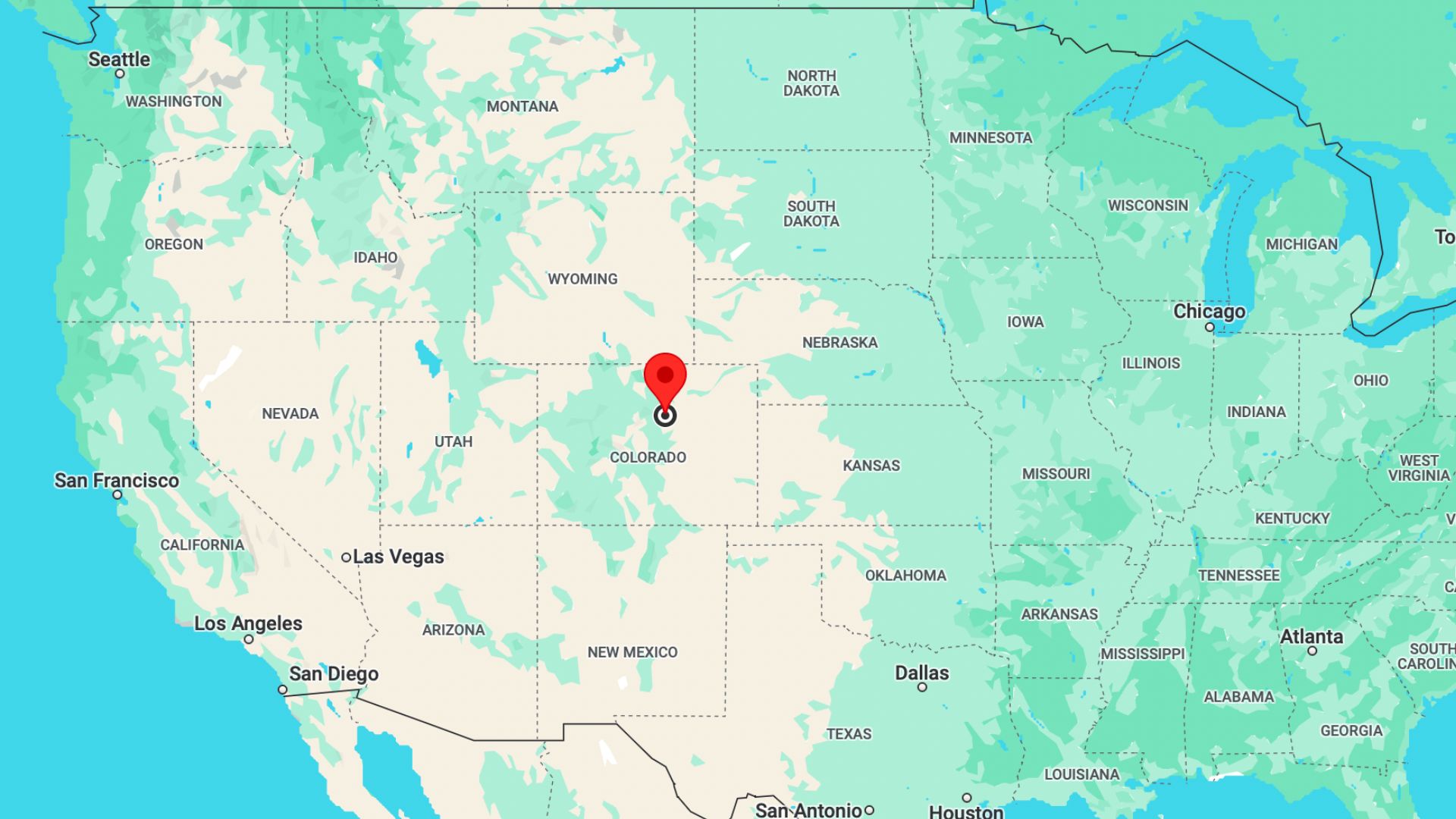
I do not consider myself “from” a particular state or town. I lived the longest in North Carolina and Colorado, at 3.5 years and 5.5 years, respectively, but both of those stretches were interrupted by residences in different states in between. My parents and sister now live in the Denver metro area, where I went to university and spent a bit of my early 20s in, so I’ll now claim it as “home” when an asker can’t believe I don’t feel such affinity to any specific location.
I have “moved” a total of 26 times. I have lived in 14 U.S. states plus the District of Columbia. I’ve lived in Virginia, North Carolina, and Colorado more than once. I moved twice within four locations (Oklahoma, North Carolina, Washington, D.C., and Amsterdam) and four or five times within the Denver Metro area. I’ve completed two cross-Atlantic moves– once with my parents to Rome and once alone to Amsterdam. Hopefully, that adds up to 26, but even I still find it hard to keep track.
So then… is there anywhere you feel most at home?
If I say I’m going “home” to the U.S. in casual conversation, this could also include some places where my friends or family reside – home is where the heart is, right? For instance, I could be referring to Chicago, where three of my closest friends and non-blood related aunt and uncle live, Michigan, my parents’ birthplace and home to my maternal grandmother and extended family, although I have never lived there. I could also be going “home” to Portland, Oregon, a place I’ve also never lived but where my maternal aunt’s family is, or wherever Emma McCauley, my youngest (but non-blood related) sister, and longest-time friend, lives (currently Charleston, South Carolina).
Where was your favorite place to live?
When someone asks me about my favorite place to live, I usually tell them the city I currently reside in. Since I am now an adult, I’ve consciously decided to live here, wherever “here” may be at any given moment. So, at the moment, the answer is Amsterdam, but in the past, it has also been Denver, D.C., and Philadelphia. There is the caveat of my time spent in Minneapolis – I apologize to the Land of 10,000 Lakers, as it is a beautiful state with lovely people. Still, I had a difficult time there due to personal and career-related issues.
This sentiment might change in the future, especially as my parents grow older or I have a family of my own, and the decision to live or move wherever is no longer mine alone. For now, I am happy to be where I am and choose to be.
But putting formalities aside, what places did you like to live most?
The bases my father was stationed at are not places you would willingly want to live. We never went to Germany or Korea, although my parents and sister did get to go to Rome without me. Lawton, Oklahoma (my residence from ages 4 to 6) is a fairly abysmal middle-of-nowhere place, crawling with creepy scorpions and pesky armadillos with little to do. Rapper J. Cole has lengthily documented Fayetteville, North Carolina, as the “super hood” and “Fayettenam,” which comes close to my experiences (from age 12-14 and 15-17).
I’m not sure if Arizona was my favorite place then, as I was surely distressed when we first moved about being ripped away from my friends in Georgia. Still, I think Ft. Huachuca, AZ comes out on top of my childhood homes. Admittedly, It is not particularly a place I would ever return to live as an adult; 20 miles from the Mexican border in desert mountains and an hour and a half from the nearest department store, Ft. Huachuca is much too remote for the metropolitan life I enjoy these days. But it was naturally beautiful and culturally diverse. It was also a military bubble, isolated from outsiders – one of the few times I could enjoy the company of other children. I knew I wouldn’t disappoint when I told them we would be moving.
How have all the moves affected you?
“Roots” and “stability” are two concepts I’ve been struggling with in therapy since I started recognizing my restlessness problem in my early twenties. I recognize this feeling is not mutually exclusive to military brats. As I near 30, I still long desperately for a place to call my one true home but often feel no closer to finding it and may accept that I might never.
The summer before my senior year of college, my sister, parents, and I were finally reunited and living within an hour of each other after being separated by the Atlantic Ocean for the previous three years. My sister was at the same university as me in Golden, Colorado. My dad had been stationed at Peterson Air Force Base in Colorado Springs. He was set to retire and move closer to us in the Denver Metro area to work for the federal government after I graduated. Right when our family was about to be reunited, the “itch” took me away again.
When I started looking for my first job out of college, there was no question in my mind that I would leave the state. Despite my love for Colorado and my family and friends residing there, I always felt I would “have to” leave the state. The check-out time of this hotel had come; it was time to move on, like I’d always done.
How has relocating as an adult differed from your childhood experiences of moving?
As it turns out, starting over as an adult, even in your early 20s, is much more difficult than starting over as a child. I learned this the hard way during my 10 months in Minneapolis. Finding community when you’re living alone and working long hours can be extremely difficult—coworkers aren’t the same built-in friends that schoolmates are. I ran back to Denver with my tail between my legs, counting my blessings on the friends I already had there.
In February 2020, I decided to try my luck again in Washington, D.C., after accepting a very exciting job offer. I had a plan – what sports and associations to get involved in to meet people, and I’d live with social roommates that I could hang out with. Unfortunately, a little worldwide pandemic quickly pulled the plug on my plans.
I’ve been in Amsterdam since summer 2021, and although I treasure the time I’ve spent here, it’s been a challenge in its own right. Although I’ve navigated American southern, midwestern, northeastern, and Western cultures, the culture shock and barriers in coordinating a group of Dutch, Italians, Chinese, and Brazilians are incomparable. Every time someone tells me our dinner reservation is for 8 p.m., I still die a little inside.
However, Amsterdam is an incredibly social and open city. Thousands of other expats here are also looking for friends and community, trying to make this country feel a little more like home. In that way, it feels a little like living on a military base with other transients. On that same note, it makes it quite difficult to ever really feel at home. There’s a sense that many will float back to their countries of origin one day, so Dutch folks tend not to get so close to outsiders for that reason (which was something I experienced in my non-military schooling at times). The international atmosphere sometimes makes it feel like I don’t even live in the Netherlands.
As I’ve gotten older, I’ve come to appreciate the positives my upbringing brought me– many of my friends in college had never left their home state of Colorado (although it is a fine state to never have left), let alone the country growing up. Every other year, I’ve been surrounded by new and different people from different socio-economic, racial, and cultural backgrounds. Although I’ve never had a long-lasting experience of community, I’ve learned to craft my own wherever I go.
I’ve doubted myself and my new place in society with every move. In North Carolina, I didn’t have a feminine enough sense of style; in Colorado, I felt too Type A; in D.C., I wasn’t Type A enough. For my first two years in the Netherlands, I constantly questioned whether the language barriers and American stereotypes were too big to overcome. I’ve pined for “home” at each new location, daydreaming of greener, more familiar pastures.
But, as they say, “Wherever you go, there you are,” slowly but surely, I’m learning that no place is better or worse than the other. People are also people; there are kind, loving, anxious, depressed, rude, and awful ones everywhere. This is particularly true of modern dating, which, if my other single friends scattered across the globe are a good indication, is “miserable” in every city. How I’ve experienced a place completely depends on my values, priorities, opportunities, and life stage at the time. `
In Part 2 of “Peyton’s Army Brat FAQ,” I’ll get a little more into the nitty-gritty of the military’s role in our family’s moves and my upbringing. What does one even “do” in the military? How has my family been affected by war? Did I grow up with an arsenal in my basement? Stay tuned for all that and more, and feel free to send any other questions you may want answered to thoughtshub2021@gmail.com.
About the author
Blog writer Peyton moved to the Netherlands in 2021 to pursue a master in Spatial & Urban Economics at the VU. Since then, she’s continued her work in the built environment industry– she was previously in Washington, D.C. supporting policy work on climate resilience and urban sustainability. As a former military brat with no real hometown back in the U.S., she decided to give the Netherlands a go at becoming her new home. In her free time, Peyton enjoys hanging out with her triathlon club (but cycling is her favourite), reading, writing, learning Dutch, and spending time enjoying good food and company with friends. She is also an urban enthusiast– passionate about understanding the vibrant ballet of life on city streets and the heartbeats of community identity. Peyton will be writing blogs every other month.
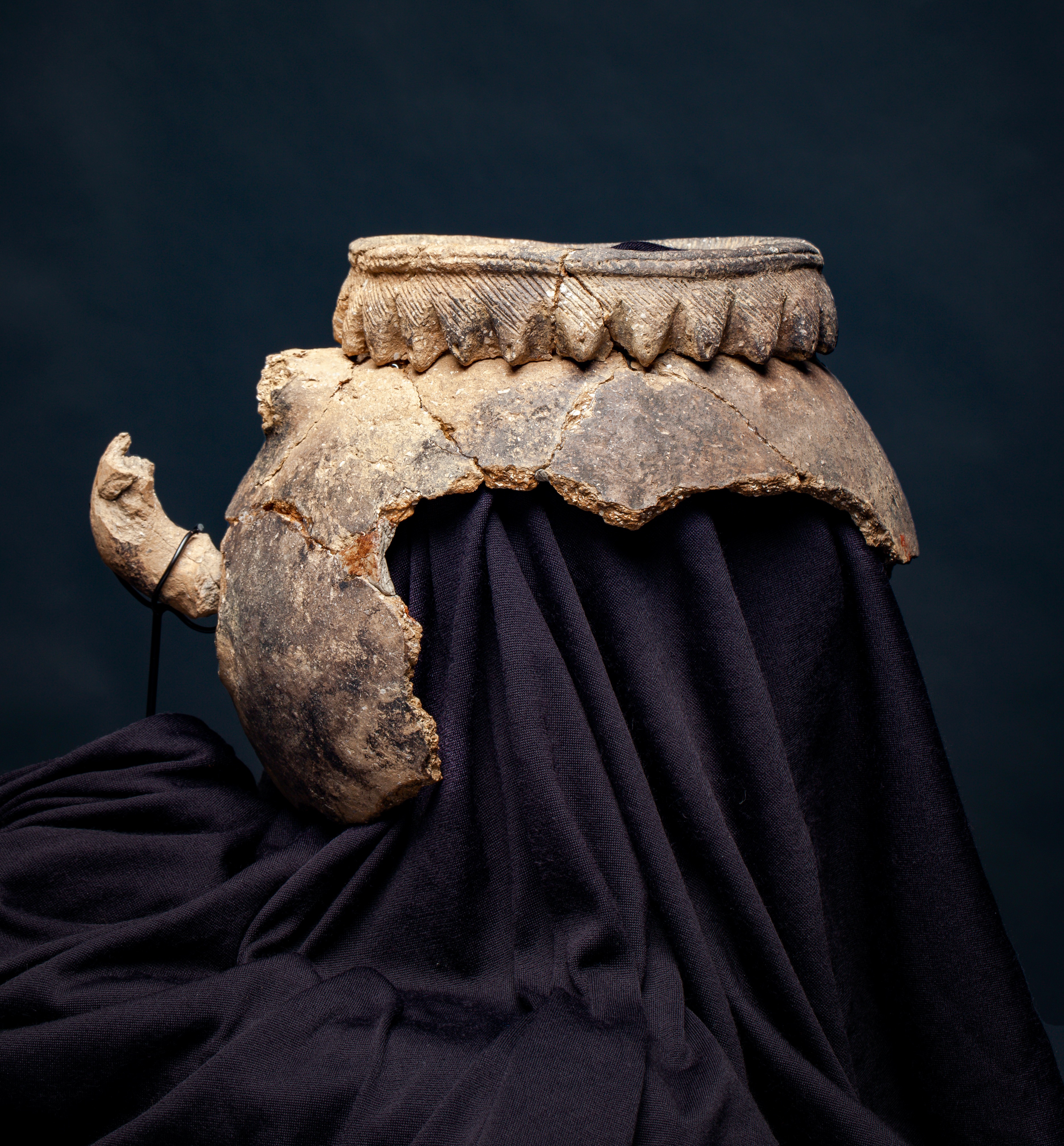
In this short conversation with The John Adams Institute, Donnamarie Barnes, the Director of History & Heritage at Sylvester Manor, explains a transatlantic story. In this excerpt, she tells the story of the transatlantic slave trade through a seemingly innocuous archeological finding: a stone pot.
Very often, when telling the history of women’s suffrage, we focus only on the major achievements, telling the stories of the most recognizable activists such as Elizabeth Cady Stanton or Susan B. Anthony. Before the 19th Amendment was ratified by the U.S. Congress and Senate in 1920, women had been fighting for over 150 years to attain the right to vote. By telling the story of lesser-known women who also fought and rallied for the rights to vote, we contribute to an unequivocally more inclusive timeline of general suffrage history.
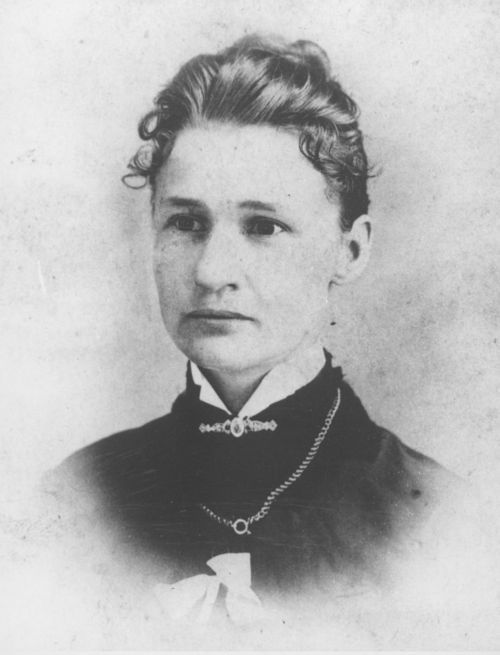
It was 1789 when the state of New Jersey became the first to allow any person with property, regardless of sex and race, to vote. The progressive decision would only last for eight years, but it set the beginning of a long century of reforms and activism, the perfection of democracy and the first steps towards the recognition of men and women as equals. The protagonist of today’s article was born on March of 164 years ago in Lamira, a small community in Ohio. Her name was Susanna M. Salter and I encourage everyone to read along to discover how she became the first woman mayor in the history of the United States.
A picture of Susanna M. Salter taken around the same year that she was elected as mayor of Argonia.
Daughter of Quaker parents, she was the descendant of the first English settlers that arrived to the United States with William Penn. After living her youth in Silver Lake and whilst in school, she married Lewis Allison Salter and together with her parents they moved to a little farm in what would, in 1881, become the small city of Argonia in Kansas. Shortly after her marriage, Salter became involved with the recently founded Woman’s Christian Temperance Union (WCTU). An important player in the Temperance Movement against the consumption of alcohol that would eventually culminate with the 18th Amendment, the WTCU became already by 1890 the largest women’s organization in the world.
The rapid growth of the Union in the late 19th century translated into the involvement of the WTCU in other political issues such as those related to prostitution, labor and, most notably, suffrage. Under the direction of Frances Willard, the organization adopted the motto “Do Everything” and, as it got involved more into politics, its role in the eventual passing of the 19th Amendment also became bigger in parallel to other more recognized organizations such as the NWSA or the AWSA.
In 1887, Kansas — that some years before had been the first state to hold a referendum on women’s suffrage — became also one of the first states to grant women the vote in municipal elections. That same year, Argonia, having been established as a municipality in 1885 and with a population of about 500 people, held its second municipal elections and the first in which women could vote. The previous term had elected Salter’s father as the mayor and her husband as the clerk, which, added to the fact that she was a member of the WTCU made her a quite popular character in the small city of Argonia.
Just as it happens every time that progress is made, the news of a woman’s enfranchisement in the upcoming municipal election was met with opposition amongst many men in Argonia. On top of that, the WTCU chapter in the city announced that it would support any candidate who made alcohol and tobacco prohibition a top priority in their political program. A group of men who believed that politics should be reserved for their sex decided to play a trick on the WTCU slate of candidates. As chance had it, the only eligible woman of the WTCU Argonia’s chapter was Salter; the men partaking in the complot copied the slate of the organization but changed the name of the mayor candidate to her first name, Susanna. Thinking that no men would vote a woman as mayor, without the knowledge or consent of Susanna, they printed the ballots and hoped that their little trick would undermine the prestige of the WTCU and demonstrate that women should not play any role in politics.
The morning of the election, Salter was contacted by the Republican party once one of its members noticed her name on the ballot. Asked if she would serve if elected, Salter responded affirmatively and after a quick meeting with the representatives of the party received their official support. Together with the support of the Prohibition Party, politically aligned with the WTCU, she ended up receiving two thirds of the total votes. What started as a trick from a group of angry men had ended with the election of Salter, 27 years old at the time, as the first ever woman mayor in the history of the United States.
Her election caused a sensation among the newspapers of the whole nation, and during her year as mayor she was visited by many correspondents from other states, making the little city of Argonia into a temporary tourist hot-spot. Even though her term as mayor lasted only for one year, the news of her election crossed borders as she received letters of congratulation from countries such as France, Germany or Italy.
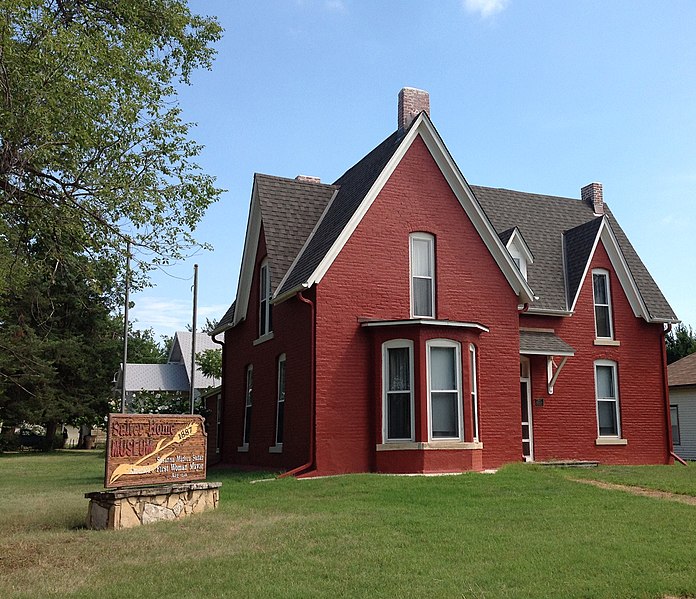
The house of Susanna M. Salter in Argonia, today turned into a museum and part of the National Register of Historic Places.
One of these letters, from Willard, the president of the WTCU, encouraged Salter to write “a note that I can read to audiences, showing the good of woman’s ballot as a temperance weapon and the advantage of women in office”. The following years allowed her to become a speaker in women’s suffrage conventions sharing, at least once, the stage with Susan B. Anthony.
Shortly after Salter’s term in office and choosing not to continue a career in politics, the whole family moved to Oklahoma and eventually settled, after her husband’s death in 1915, in Norman, a bigger city where her children could attend university. Little is known about her later years and, although she remained interested in politics for her whole life, she never sought to be re-elected or took any relevant political roles after her one-year mayor term.
Susanna M. Salter died in 1961, at age 101, in Norman, Oklahoma, although she was buried in the still today little city of Argonia, the place that made her the first ever woman to be elected as mayor in the United States.
Dario is a student in American Studies at the University of Amsterdam. He has previously completed a bachelor in History at the University of Zaragoza and bachelor in Communication at the Universitat Oberta de Catalunya. During his bachelor years, he also had the chance to study abroad in countries such as the U.S., Italy or Romania, which have made him specially interested in transnational movements and perspectives. He is currently writing a dissertation on the unpublished autobiography of Vaughn Love, one of the African Americans who fought in the Abraham Lincoln Brigade during the Spanish Civil War. In his free time, Dario is also a member of the Young Minds Network of the John Adams Institute in Amsterdam.
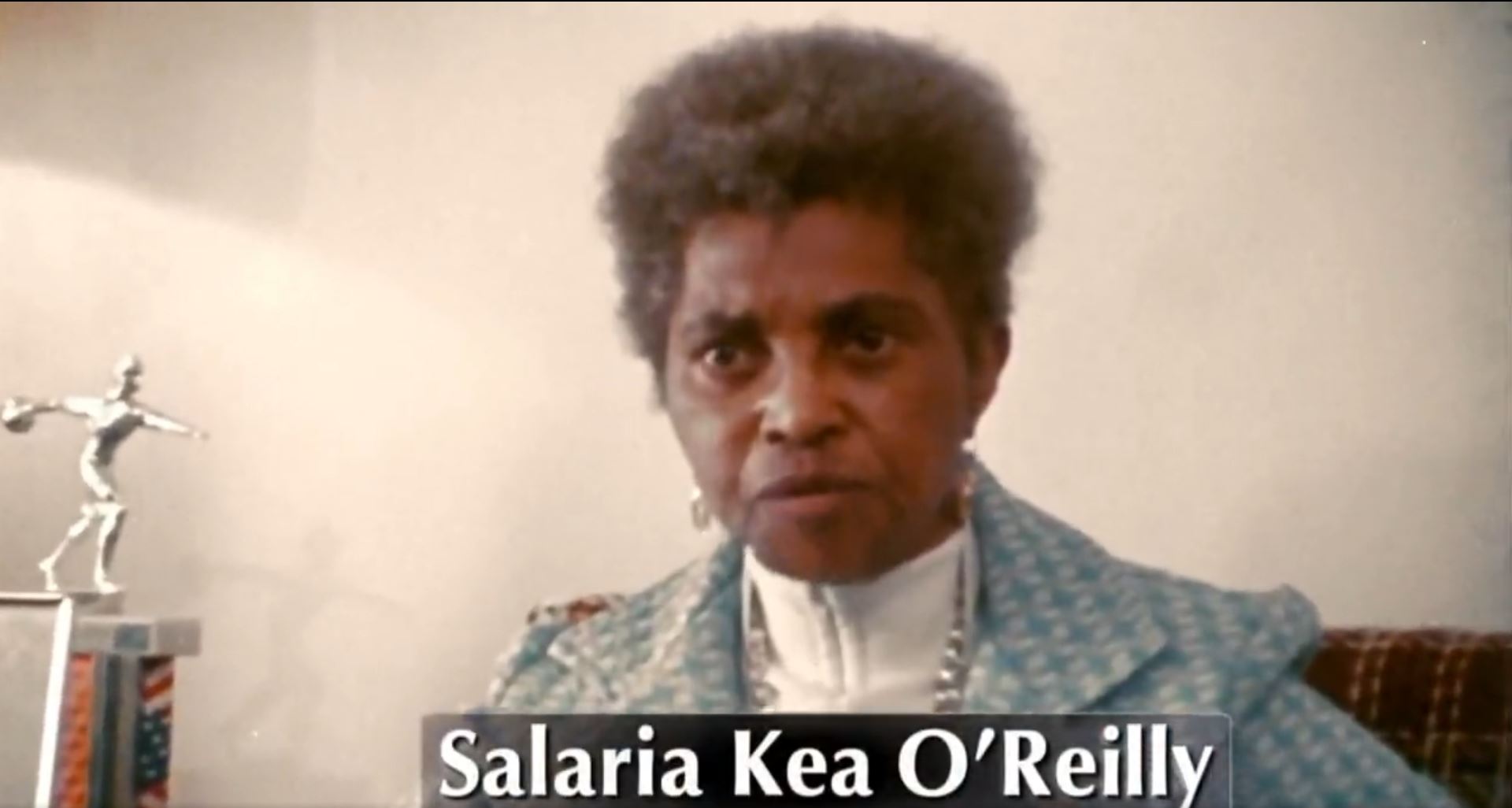
Salaria Kea, born July 13th 1913 in Georgia, the “Empire State of the South”, is the first woman in this series of short articles dedicated to Women’s History Month. Instead of writing about some of history’s better known characters, we have decided to focus on those great American women who forever changed history and whose memories we ought to do justice to, but who have often been forgotten or silenced.
Salaria Kea has a Wikipedia page, and is the subject of a couple of book chapters and a few scattered journal articles, but if we mention her name, even among historians, no one seems to know who she is. A nurse by profession, Salaria Kea was to become the only African American woman to fight fascism in the Spanish Civil War of 1936. But she was more than just a nurse: her life is a journey of activism, participating in the early path towards the Civil Rights Era, whilst also rallying for international causes such as opposing the Italian invasion of Ethiopia in 1935.
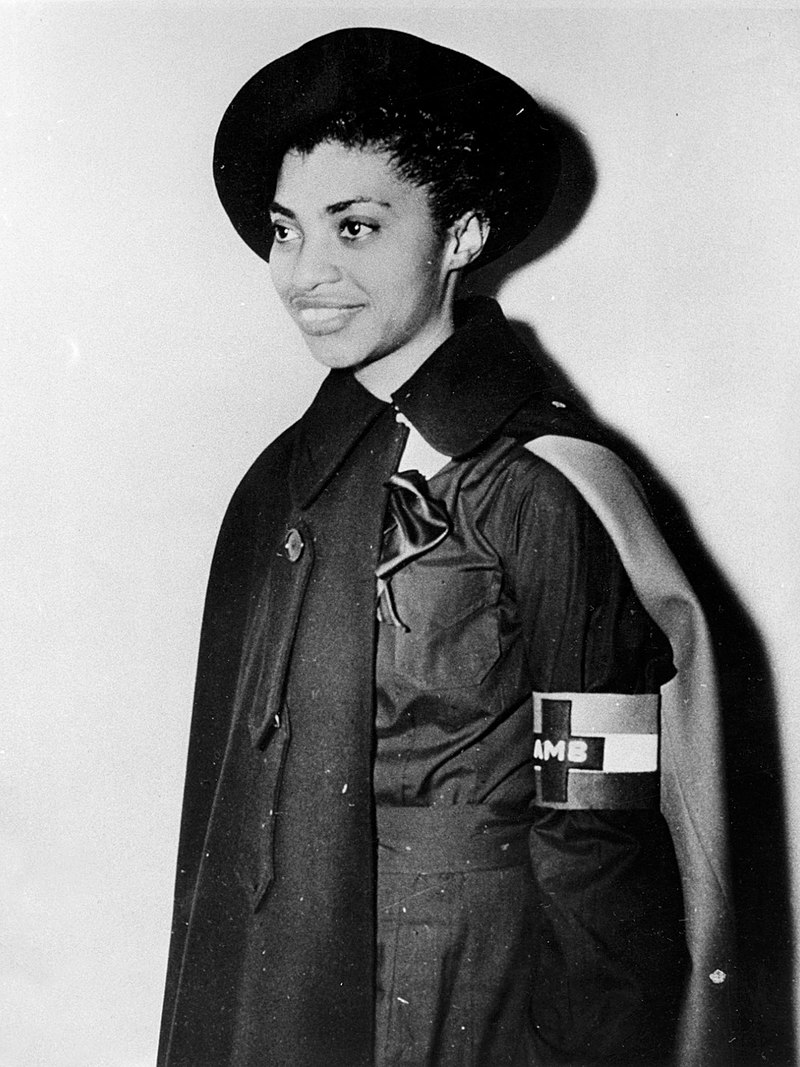
A picture of Salaria Kea taken sometime during the Spanish Civil War, on it we see her wearing the military medics uniform of the International Brigades.
Born in the deeply segregated American South, Kea faced challenges and adversity from an early age. After the death of her father, stabbed whilst he was working at a Sanitarium, her mother had to leave 6-month-old Salaria and her 3 older brothers in the care of family friends to be able to work and raise her children. But after two years, her mother returned to Georgia to marry a farmer, and Kea remembers that her brothers had to take care of her while her mother was away. It was her brothers who, working small jobs instead of going to school, ensured that at least the youngest sister could pursue an education.
It was during the last summers of high school, while working at a local doctor’s office, that Kea was introduced to her calling and future profession: medicine. But it was not that easy for her, and suffering from the harsh segregation laws of the South, she watched one school after the other deny her entry simply because of the color of her skin. Following the path to the North that many African Americans had to embark upon after the Great Depression, Salaria headed for New York. It was 1930 when she finally got accepted in the Harlem Hospital School of Nursing.
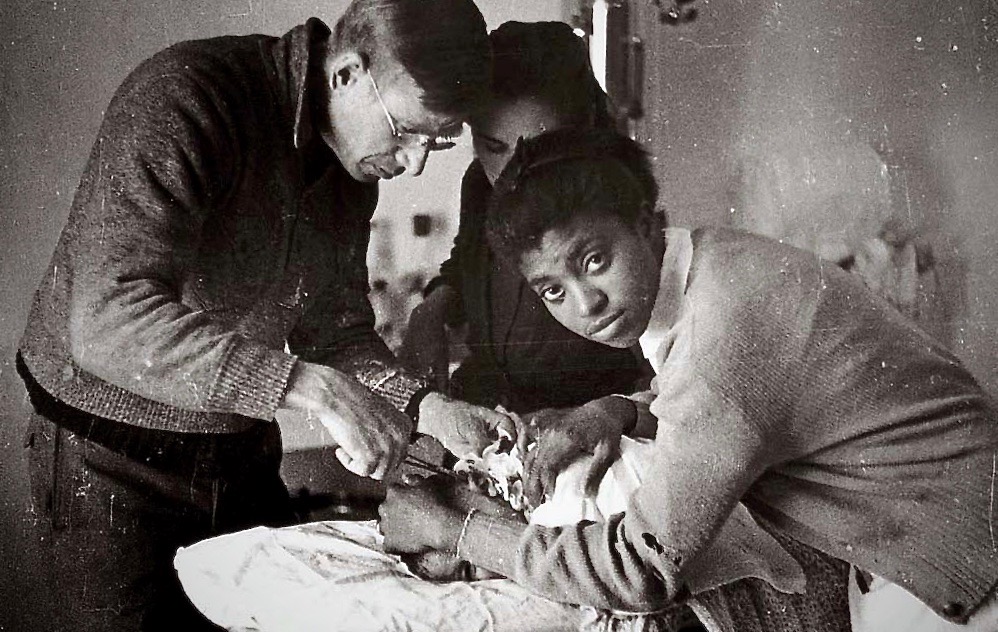
Salaria Kea operates a soldier wounded during the Spanish Civil War.
Almost 30 years before the now-famous Greensboro sit-ins, Kea and some of her schoolmates, protesting the racial segregation rules of the school, rejected to stand up from a “Whites Only” table at the dining room. Kea’s first experiences in organized protest eventually led to the school ending segregation in the dining areas. In 1934, she graduated and, shortly after, started to work in various hospitals where, meeting with the most progressive nurses, she increasingly became more politicized.
When in the Fall of 1935 the fascist troops of Mussolini invaded Ethiopia, Kea was ready to get into action to support what was hailed as the last free country in Africa. Together with other nurses, they raised enough money to send 75 beds to Ethiopia. When the troops of Mussolini, following Franco’s coup d’etat in 1936 entered the Spanish peninsula, Kea knew it was her call to volunteer to fight for the antifascist Spanish Republican side.
On March 27, 1937 Kea sailed for Spain aboard the Paris. Following the path of around 2,800 other American volunteers to fight in the Lincoln and Washington Brigades, she would be the only African American woman amongst them (in total around 85 African American men would also fight for the International Brigades). Assigned to a medical unit, Kea was responsible, during her first months in Spain, to turn the abandoned summer residence of king Alfonso XII into the Hospital Villa Paz. The old palace had been occupied by cattle, infested by mosquitos, and the plumbing and electricity were no longer working.
The front and end page of the 1938 pamphlet A Negro Nurse in Spain, which narrated the life of Salaria Kea and was used to raise money for the Spanish Civil War.
Kea noticed that amongst the Republican women helping to fix the building into the hospital, most of them could not read, and so together with other international nurses, and in only six months, not only did they finish the project, but also taught everyone who worked there how to read and write. Soon the hospital, that never ceased to be operated in the harshest conditions, was filled with Ethiopians, Cubans, Americans, Italians, Germans and all the nationalities of the international brigades.
During the Aragon Campaign in early 1938, Kea was moved to the front to treat the patients that were in most urgent care and couldn’t be moved to the hospitals. In a pamphlet published shortly after her return to the U.S., she remembered how, in the midst of the battle, with planes of both sides flying above, “they battled just over our hospital unit. We could hear the stray bullets as they fell through the olive trees.”
During one of the fascist bombings, Kea lost the rest of her unit and had to hitchhike all the way back to Barcelona, where, in the last attempt to resist the fascist advance, the international troops had been stationed. But with the powerful German and Italian aviation supporting Franco’s army, it was only a matter of time before the International Brigades and the Republican troops would be forced to retreat. And so, sometime in March 1938, one of the bombings left Kea under 2 meters of rubble and, seriously injured, she was eventually sent back to the U.S.
Salaria Kea explains during an interview the reasons for which she decided to volunteer for the Spanish Civil War.
Back in New York, she continued to organize convoys of medical supplies to be sent to Spain and, after the International Brigades where finally dismantled and survivors returned home, she was also active amongst the Veterans of the Abraham Lincoln Brigade (VALB for short, now Abraham Lincoln Brigade Archives, the organization behind the archive collections and whose activities keep the memory of all the American volunteers and their struggle against fascism in Spain alive). In a 1938 pamphlet narrating her story to raise funds for the still ongoing war, she ends with a note: “Surely Negro people will just as willingly give of their means to relieve the suffering of a people attacked by the enemy of all racial minorities, – fascism – and it’s most aggressive exponents – Italy and Germany.”
After the civil war in Spain ended, Kea would also fight overseas as a nurse during WWII. Back home in Akron, Ohio, Kea and her husband, John O’Reilly – an Irish volunteer of the International Brigades that she met and married while they were in Spain – would live a peaceful life still working against fascism, “the enemies of the world”, as she would put it. On May 18th, 1990 Kea passed away in her home.
Hers was a life of struggle and activism, of constant opposition to the hardest realities of the world: discrimination and fascism. Her story is one of intersectionality, as a Black woman and a nurse in a war that was happening thousands of kilometers away from her home. Today, this month, but forever, we ought to remember and honor the life and legacy of Salaria Kea.
Dario is a student in American Studies at the University of Amsterdam. He has previously completed a bachelor in History at the University of Zaragoza and bachelor in Communication at the Universitat Oberta de Catalunya. During his bachelor years, he also had the chance to study abroad in countries such as the U.S., Italy or Romania, which have made him specially interested in transnational movements and perspectives. He is currently writing a dissertation on the unpublished autobiography of Vaughn Love, one of the African Americans who fought in the Abraham Lincoln Brigade during the Spanish Civil War. In his free time, Dario is also a member of the Young Minds Network of the John Adams Institute in Amsterdam.
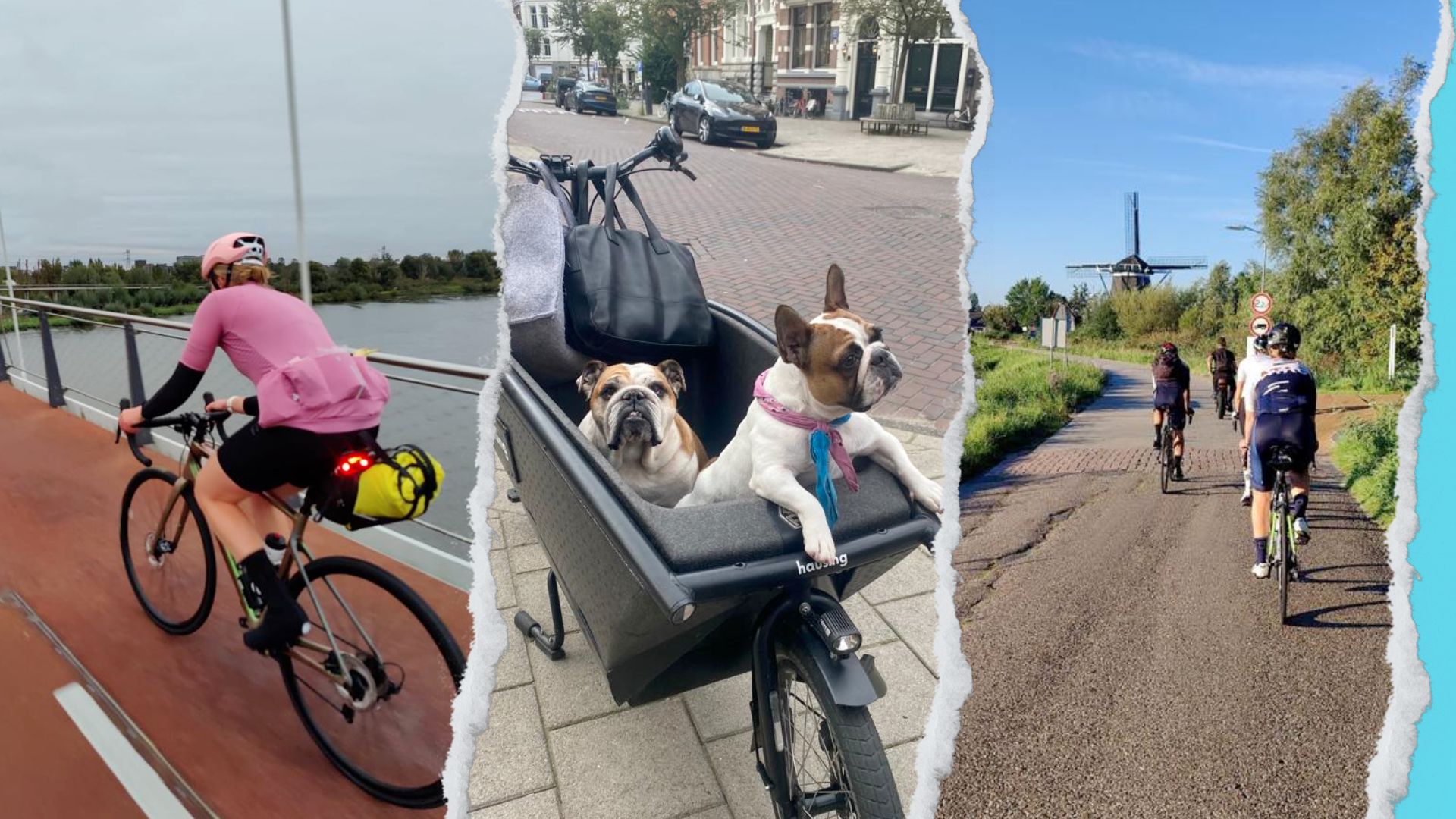
On any given week in Amsterdam, I spend at least seven or eight hours on a bike. About four to five of these hours are for leisure, out on my prized race bike, a brand new beetle green Cannondale. Road cycling is a hobby I have long been interested in. I finally picked up the hobby last summer with the help of my local triathlon club. The other two or three are spent commuting on my city bike. These quick rides, whether it’s an eight-minute journey to my gym/co-working space in the morning, twelve to Dutch class on Monday evenings, or nine to my friend’s house for dinner, often bring me as much joy as my long weekend ones. From my saddle, I am the prima in the daily ballet of city life.
Growing up on various rural American military bases and suburban subdivisions, my relationship with cycling wasn’t always so ingrained. When I was sixteen, my parents helped me buy my first car solely to help run errands. At first, I was excited by the freedom. I had a tenuous sense of liberation. After a year or so, I realized that their gift to me was more beneficial to them. With my driving in the mix, there was no more ferrying us to school at the crack of dawn through 25 minutes of traffic and red light and no more three-hour round-trip drives to basketball games in the middle of nowhere on Thursday nights.
Golden, Colorado
When I entered college at seventeen, tired of the responsibility of the driver’s seat, I acquired a student transit pass. Within my first week in Colorado, I figured out how to take regional transit into Denver. There, I wandered down an empty city street to spend my hard-earned summer job and graduation money on the nicest used bike I could find. The bike I bought home with me on the light rail was by far the most expensive thing I had ever bought. The entire way home I imagined all the adventures it could take me on.
As freshman year rolled by, my bike saw daylight only once. The petite, hilly campus didn’t warrant a bike, and the surrounding areas were better explored by car. When I moved into a sorority house from the dorms, I brought my bike out of storage and locked it at the back entrance. A few months later, I noticed the bike rack empty again. The most expensive thing I owned, gone! I had barely even ridden it!
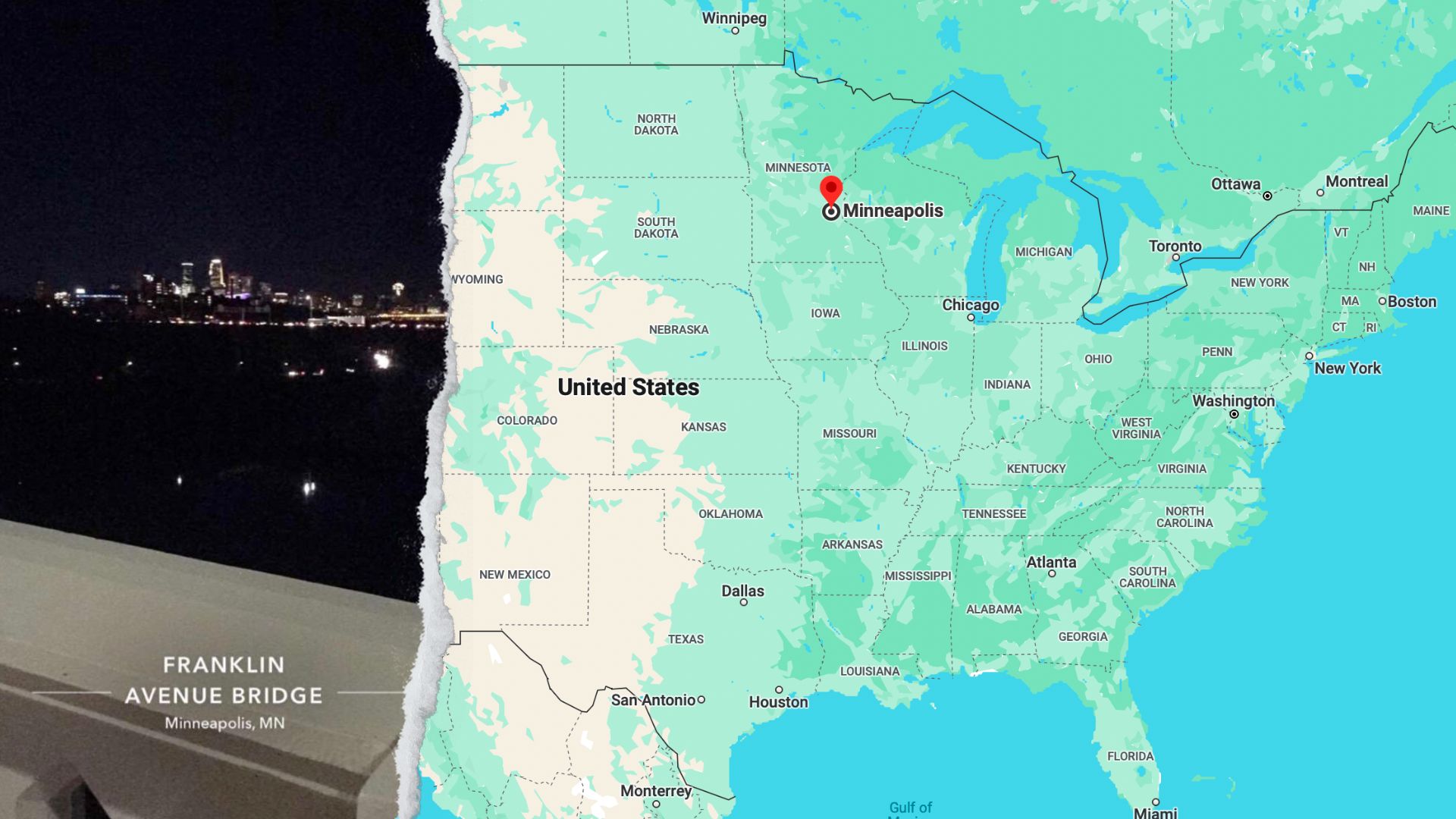
Minneapolis, MN
I put my cycling dreams on hold, vowing that I would pursue them again after I’d graduated, gotten a job, and moved to a real city with painted green bike lanes. My opportunity to get on two wheels again came when I moved to Minneapolis in the summer of my twenty-first year. I found myself leaving another used bike store, this time with a modest, dull gold city bike with slimmer tires than my first.
The Midtown Greenway, once a railroad corridor, now a multi-use path, became my route to work. As summer gave way to fall, I frequented the on-road bike lanes and leafy scenic trails, reducing my car usage by almost 60%. Fall slowly turned to winter. Each morning I burst with pride as I figured out how to layer my clothes and fit my belongings into my bike bags to shower at the office after a sweaty 30-minute ride. I reveled in the quiet, dark mornings, never tiring of the murals along the walls of the below-grade trails and the smell of fresh sourdough from a nearby industrial bakery.
My daily rides were sanctuaries I clung to, the rare moments I could breathe fresh air and immerse myself in my community. These treasured respites were all the more precious when set against the backdrop of grueling 10-plus-hour shifts in a stuffy office. All was going well in my cycling world; until the snow came.
The first day the streets iced over that December I thought, “How bad could it be?” On that pitch-black Northern winter morning, it took me less than a block to find out. My bike slipped right out from under me, ripping my pants down the middle, and immediately adding splashes of black and blue on the entirety of my upper right thigh. I walked my bike back into my apartment with my tail between my legs. I would have to drive to work.
After braving the weather in Minneapolis for less than a year, I quit my job and ran back to the Mile High City, aimless and wandering. I ended up in my parent’s basement in the sprawled Denver suburbs, a community not conducive to getting anywhere by bike, foot, or anything other than a car. So, while I revamped my career and bank account, my bike collected dust in their garage for over a year.
Denver, Colorado
After moving out and into the heart of Denver, I was finally able to get around for most of my daily chores by bike or foot– except for work. There was an unfortunate imbalance. Although the drive was a quick 14 minutes, it took about an hour to cover the 10 miles by bike.
Cycling to work wouldn’t be an everyday possibility, but I was determined to try it out at least twice a week until winter came. Once again, I stuffed my bike bags with all the things I would need to give myself a bird bath (no shower at this office!) and change. At five-thirty in the morning, I began my journey along the waters flowing from the mountains, and out into the sleepy suburbs past skyscrapers, an enormous (American) football stadium, and roller coasters from the city’s theme park.
This continued for a few months when the paths’ conditions allowed until I got a new job based out of Washington D.C. I was excited to get back to a city with better bike infrastructure. I was leaving my car in Colorado!
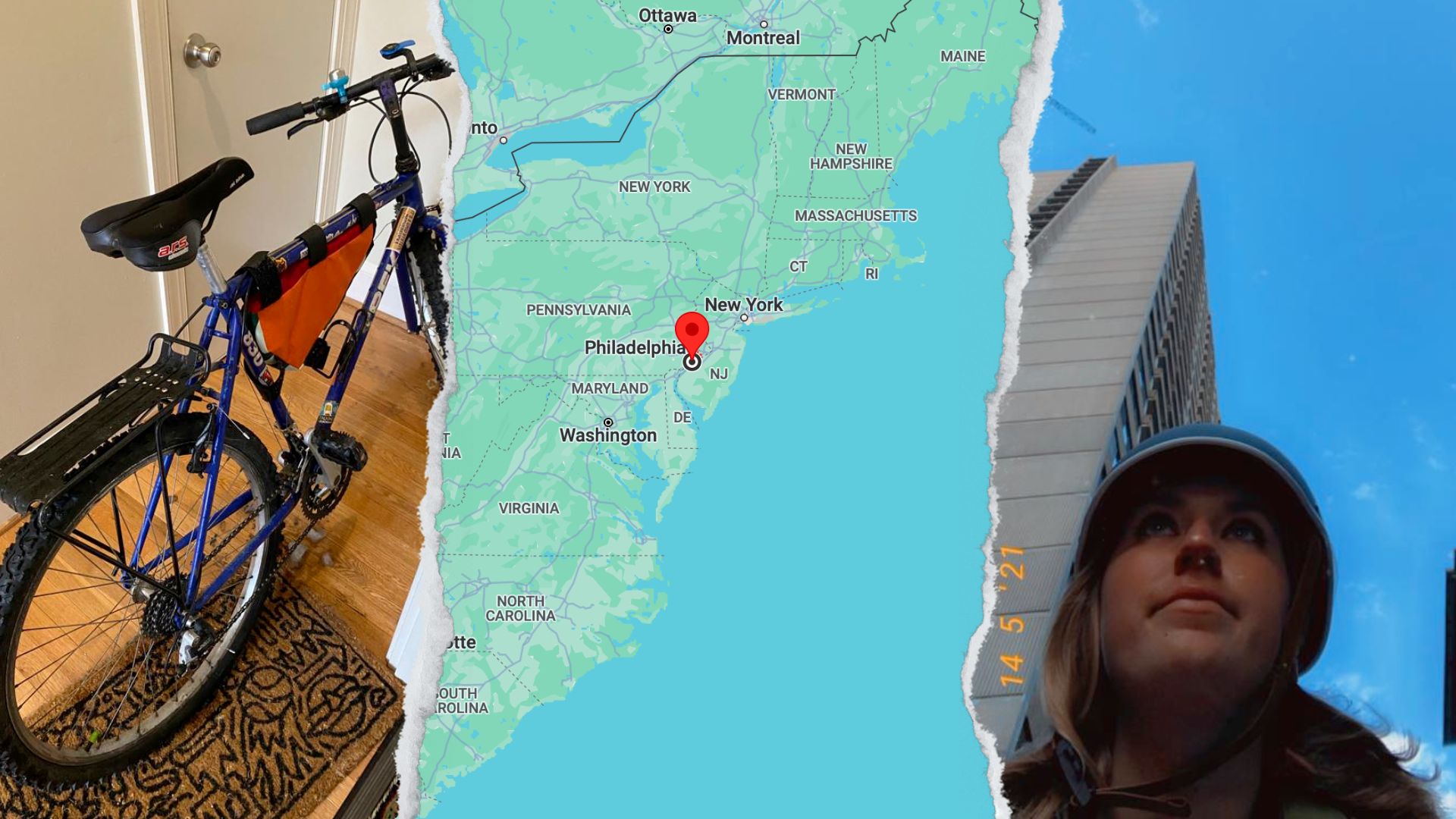
Washington, D.C., DC
In February 2020, my mom and I loaded my beloved bike into a rented box truck and drove it through the cornfields of Iowa and the mountains of West Virginia to the US Capitol. One month later, I found the move I had long been awaiting was not particularly well-timed. I barely had time to figure out which grocery store in my neighborhood I preferred, let alone make any friends before the pandemic shut the city down. So for the next year, I took advantage of the one place I was allowed to go– outside. And boy, was I glad I had my bike.
With it, I explored the marshlands and grand, granite plaza of Teddy Roosevelt Island. I cruised down the Chesapeake & Ohio Canal Trail, now a 185-mile natural respite for cyclists and runners, but which once carried coal from the mountains down to port. I discovered Rock Creek Park, where the National Park Service had shut down the main roads for residents to enjoy the urban oasis of dense forests and streams.
I also explored the urban side of my city– tracking down interesting murals, public transportation landmarks, and a few ‘boundary stones,’ ancient relics of the District’s first survey. I spent many fall evenings splayed out with my bike and a good book surrounded by monumental Smithsonian museums on the great yard of the National Mall.
In February 2021, I was working from home when I received the most exciting news most could imagine at the time. Someone hadn’t shown up for their vaccine, and I was on the waitlist. Could I come to the hospital right now? I squealed with joy after hanging up the phone, shot my boss a “found a vaccine, see you later sucker” text, snagged my helmet off its wall hook, and dashed out the door to unlock my bike.
But when I reached the spot in the fence where I had locked my bike the previous night, all I found was a broken wrought-iron post. My bike, my most prized possession, had been ridden off into the night by a very determined thief. Again. I was devastated. I collapsed onto the neighbor’s patio chair, tears falling down my face. The cold, concrete street corner had plenty of passersby even though it was the middle of a workday. Most were wearing sweatpants, walking their dogs, and grocery shopping, but it was more likely than not that they were White House aids or CNN correspondents. The thought of a potential legislator seeing me have a meltdown over losing my bike made me cry even harder.
I decided to put on my big-girl pants – I called my best friend and got her to calm me down and tell me what to do. We (she) decided I’d need to find an e-scooter, stat. Despite the setback, I made it to the hospital just in time to get my jab. Afterward, still reeling from the loss of my bike, I found solace in a small, jam-packed bike shop that taught skills to at-risk youth. I narrowly made my way out of the maze of stacked milk crates full of bike bells and saddles with a new-to-me bright blue hybrid. It was sturdy, strong, and soon covered in transit and city-memorabilia-related stickers to make it my own.
Philadelphia , PA
The month after I acquired my new best friend, I loaded it into an oversized SUV for my next journey to Philadelphia. I explored more by bike in Philadelphia in a short four months than most residents probably do in their lifetimes. The main throughway going north up the cherry-blossom-lined Schuylkill River was still closed to encourage outdoor activity during COVID lockdowns, and I took advantage of the car-less riverside every weekend. I cruised by the colossal set of “Rocky” stairs at the Art Museum and I watched crew races on the docks of seventeenth-century stone building rowing clubs. I made it up to Wissahickon State Park one day, where I accidentally found myself testing the true limits of my “thick” tires on mountain biking trails. My outings were well-timed with the spring season; tulips, hydrangeas, daffodils, and roses were abundant and the weather was fresh.
My best memories of these places are the two times I brought others with me for the ride. My sister and a good friend visited my new favorite city in the few months I was a resident and I took them up along the Schuylkill, hoping they’d fall in love with the sights as much as I had. In retrospect, taking non-cyclists on a 25-mile ride on my roommate’s very nice road bike in a city where drivers are not known for their patience wasn’t my most well-thought-out idea. Both had sore butts the next day, but now have fond memories of exploring Philly on two wheels.
My bike was not only for adventures in Philly– it was also a practical transportation mode for the compact, grid-planned city. Although I lived within walking distance from a chain supermarket, my loyalty to Trader Joe’s meant that groceries were a weekly trip by bike. I rode over every Sunday with a meticulously planned shopping list that ensured my two back-rack bags were perfectly packed. Not a yogurt container too large or an almond milk carton too squished. It was also my ride to dates, which was often met with apprehension and confusion. In a culture where nobody cycled, men couldn’t comprehend my need to find a good spot to lock up my bike (or why I had one in the first place).
While in Philly, I finally splurged on an accessory all the stylish American city cyclists were starting to wear: an expensive “minimalist” helmet with my monogram stickered on the side in gold letters. Other than looking cool as hell, my favorite part was the one-inch hole in the helmet covered by a magnetic piece you could pop out and secure to your bike when locking it up. No more carrying my helmet around bars and stores like a dweeb!
The day after the postal service delivered my bougie customized helmet, I also received a highly anticipated piece of mail to my online inbox. My grant application to study urban spatial structures passed the final round, and I had received funding to move to the Netherlands for a year. The land of canals, tulips, windmills, and, of course, bicycles! All of this excitement, and the only thing I could think was “shit, they don’t wear helmets there. I’ll look like a dweeb if I bring this”.
I made the most out of my final days in Philadelphia, spending the summer evenings on my bike. I often cycled over to Rittenhouse Park, where history waltzes with modernity amidst grand oak trees and French cafes. Artists set up their easels, musicians their instruments, and millennials their picnics. Young parents set their toddlers loose in the center ceramic-tiled fountain, and older gentlemen sit puzzling over the crossword. I fondly remember the bench in the middle of the park’s path where I propped up my bike to take it all in one last time.
Amsterdam, The Netherlands
In August 2021, I moved to Amsterdam; it’s hard to encapsulate how my residence here has transformed my relationship with cycling. The crowded highways of bike lanes, with their own traffic lights, signals, and norms, can be overwhelming for most expats at first. But for me, who had been trying to survive aggressive drivers on streets in the U.S., it is much easier to get around in a city where the bike is king.
Since my expatriation to the Netherlands, I have delved into the sport of road cycling and invested way too much money into way too much lycra. During the first half of 2023, I pushed myself too hard– falling into old habits of overachievement and anxiety, which spilled into my cycling training. I was starting and ending my day on my bike trainer and forcing myself outside to do sprint intervals when my body was telling me otherwise. I finally got to a point where I could barely get around town on my city bike without wanting to collapse at my destination.
Worried about my mental health, I took advantage of my company’s remote-work policy to recharge during the summer at home, staying with friends and family throughout the country. I was so burnt out that my intense triathlete workout schedule was reduced to morning walks with my mom and her dog for weeks. During the last days of my visit to the States, I hadn’t been on a bike for almost three months with mixed feelings about getting back on the saddle.
The day before I flew back to Amsterdam, I was given a much-needed gift to re-spark my passion for cycling (and life in general). Not what I expected from a last-minute Tinder date, but for twelve hours on a cool summer day I was given a generous two-wheel tour on a borrowed bike to all of the best parks, bike paths, ice cream shops, and hot dog stands that West Chicago has to offer. A much-needed reminder that I started cycling to enjoy the people and the world around me– my bike is a tool for the journey, not the journey itself.
Like the car is to Americans, bikes are to the Dutch.
Since returning to Amsterdam, I have taken a step back to reassess and redefine my relationship with cycling. I am showing myself grace by adjusting rides when I get too tired, and taking recovery days instead of pushing through head colds. I am taking more side streets on my commutes to find hidden corners, and cycling headphone-less to listen to the movement and flow of the city.
I have done the same 35km morning ride with friends almost every week for four months this year, still finding joy in the small villages and ports we pass each time. We roll through forests onto dikes, passing songbirds fluttering around marigold-covered fences and rusting silos. Riding into the rising sun through the small town of Haarlemmerliede, locals bustle about getting ready for work. Children pedal in groups to primary school with lunch boxes, and backpacks hanging carelessly from their handlebars. Exiting the village, we encounter pastoral scenes of cows and sheep. Aromas of banana bread often drift from cottages’ open kitchen windows. Our journey finishes with the scenery shifting from historic wooden windmills to modern steel turbines and silent electric trains speeding alongside us toward the city.
I still laugh when I see babies strapped to the front of their parent’s bike, slumped over, passed out, but still bobbing and bouncing around from the bumps of the brick and cobblestone. I am still impressed by the travelers dragging their suitcases behind them while pedaling, and the folks cycling across town with full-length floor lamps under their arms. Like the car is to Americans, bikes are to the Dutch.
Cycling has been a journey of discovery, challenge, and joy. It has shaped my life in ways I could never have imagined, and I am grateful for every pedal stroke. From the suburban sprawl of America to the bike lanes of Amsterdam, a bike has been my constant companion, a vehicle for exploration, and a source of endless amusement.
About the author
Blog writer Peyton moved to the Netherlands in 2021 to pursue a master in Spatial & Urban Economics at the VU. Since then, she’s continued her work in the built environment industry– she was previously in Washington, D.C. supporting policy work on climate resilience and urban sustainability. As a former military brat with no real hometown back in the U.S., she decided to give the Netherlands a go at becoming her new home. In her free time, Peyton enjoys hanging out with her triathlon club (but cycling is her favourite), reading, writing, learning Dutch, and spending time enjoying good food and company with friends. She is also an urban enthusiast– passionate about understanding the vibrant ballet of life on city streets and the heartbeats of community identity. Peyton will be writing blogs every other month.